
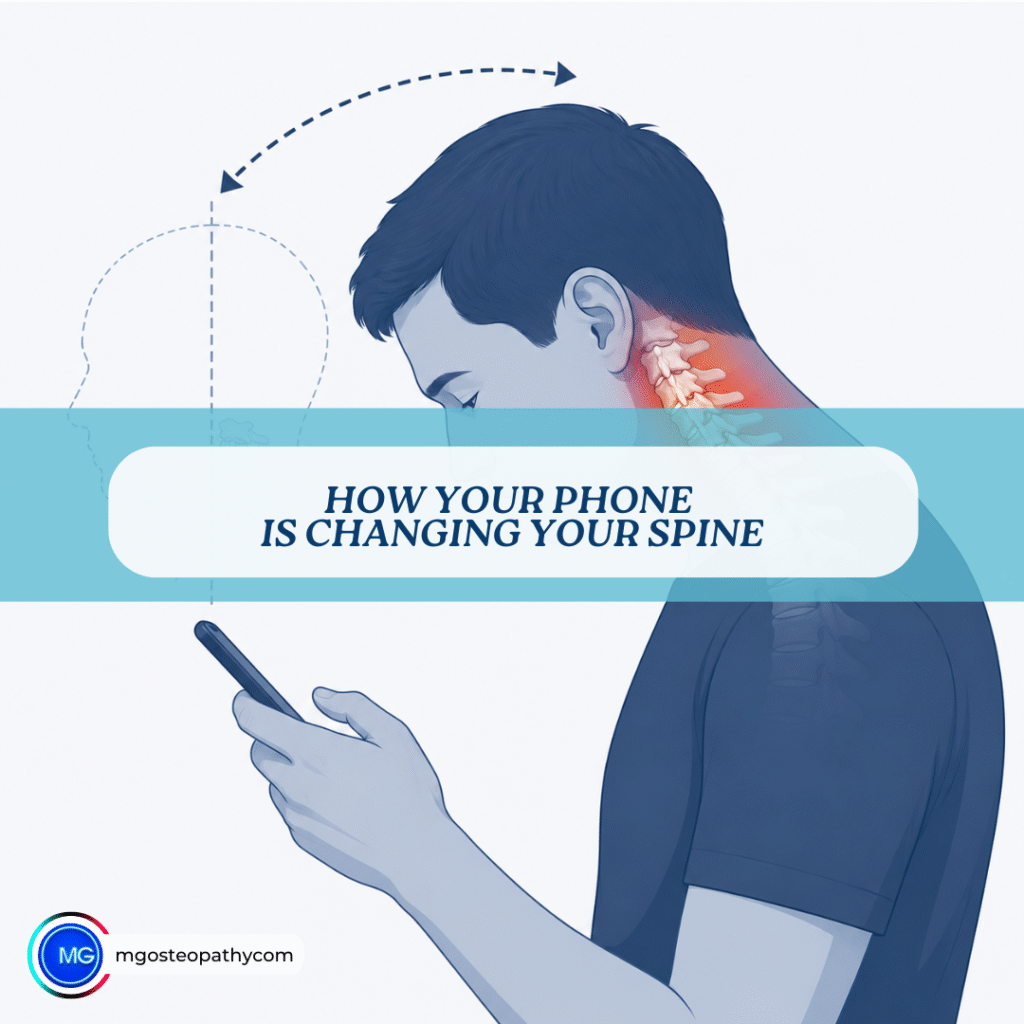
Most people spend several hours every day looking down at a phone, tablet, or laptop screen. It feels harmless. However, this repeated downward head position is quietly placing enormous strain on the cervical spine — and over time, it is physically changing the way your neck and upper back are aligned, causing what’s called a “Tech Neck”
Tech neck is not simply a term for feeling stiff after scrolling. It describes a genuine postural condition in which the natural curve of the cervical spine is gradually reduced, reversed, or distorted through sustained forward head posture. Left unaddressed, it produces a pattern of symptoms that extends well beyond neck pain — affecting the shoulders, upper back, arms, and even breathing mechanics.
At MG Osteopathy in Hackney and Islington, tech neck correction is something we work on with patients regularly. This guide explains exactly what tech neck does to your spine, why it develops, and what effective correction actually involves.
Common Symptoms of Tech Neck
Tech neck can present in a variety of ways. Common symptoms include:
- Neck pain and stiffness, particularly after screen use
- A deep ache across the upper back and between the shoulder blades
- Headaches originating from the base of the skull
- Shoulder tightness and restricted movement
- Numbness or tingling in the arms or hands
- Jaw tension and facial discomfort
- A visible forward head posture — head sitting in front of the shoulders
- Fatigue in the neck and upper back by the end of the day
Many patients also report that symptoms worsen progressively throughout the day and ease somewhat after lying down — a pattern that reflects the cumulative load being placed through the cervical spine during waking hours.
What Tech Neck Does to Your Spine’s Alignment
The cervical spine has a natural inward curve — known as the cervical lordosis — designed to distribute the weight of the head evenly through the vertebrae, discs, and muscles. The head weighs approximately five to six kilograms in neutral. However, at a 45-degree forward tilt — a common phone-scrolling position — the effective load on the cervical spine increases to around 22 kilograms.
Over months and years, this repeated stress produces several structural changes:
Loss of cervical lordosis: The natural neck curve gradually flattens or, in more advanced cases, reverses entirely — significantly reducing the spine’s ability to absorb load.
Disc compression: Sustained forward head posture compresses the cervical discs unevenly, accelerating degeneration and increasing the risk of disc bulging and nerve root irritation.
Muscle imbalance: The deep cervical flexor muscles become weak and inactive. As a result, the suboccipital muscles, upper trapezius, and levator scapulae become chronically overloaded and tight.
Thoracic kyphosis: Forward head posture almost always causes rounding of the upper back, which further compounds the cervical dysfunction.
Altered shoulder mechanics: Upper back rounding affects scapular position and shoulder movement, contributing to impingement and reduced overhead mobility.
What Causes Tech Neck?
Tech neck develops from a combination of habitual postures and physical factors that build up over time.
Prolonged Screen Use
The most direct cause. Whether it is a smartphone held below eye level, a laptop on a low desk, or a tablet resting on the lap, any screen position that requires sustained downward gaze loads the cervical spine repeatedly throughout the day.
Weak Deep Cervical Flexors
The deep cervical flexors — a group of small muscles running along the front of the cervical spine — are responsible for maintaining the neck’s natural curve and supporting the head in a neutral position. In most tech neck presentations, these muscles are significantly weak and underactive. As a result, the superficial muscles of the neck and upper back are forced to compensate, becoming chronically tight and fatigued.
Thoracic Stiffness
A stiff or restricted thoracic spine significantly limits the ability of the cervical spine to sit in a neutral position. When the upper back cannot extend fully, the neck compensates by extending from a rounded base — which alters the cervical curve and increases forward head posture. Addressing thoracic mobility is therefore an essential part of effective tech neck correction.
Sedentary Work Habits
Long periods of sitting without movement breaks allow postural muscles to fatigue and the cervical spine to gradually adopt a more loaded, forward position as the working day progresses. Furthermore, desk setups that position screens too low or too close compound the problem significantly.
Previous Neck Injury
A previous whiplash injury, neck strain, or cervical disc problem can alter normal cervical mechanics and predispose the spine to developing tech neck more readily — particularly if the original injury was not fully rehabilitated.
How Osteopathy and Physiotherapy Help With Tech Neck Correction
At MG Osteopathy in Hackney and Islington, tech neck correction is approached as a whole-body problem rather than a localised neck issue. Effective correction requires addressing the cervical spine, thoracic spine, shoulders, and the underlying muscle imbalances simultaneously.
Assessment
Every patient begins with a thorough clinical assessment. We examine cervical and thoracic mobility, head and shoulder alignment, deep cervical flexor strength, scapular position, and any neurological signs in the arms or hands.
This gives us a precise understanding of how far the postural change has progressed and which specific structures need to be addressed first.
Manual Therapy
Hands-on treatment for tech neck typically includes:
- Cervical joint mobilisation to restore movement to restricted segments of the neck
- Thoracic mobilisation and extension techniques to address upper back stiffness
- Soft tissue release of the suboccipital muscles, upper trapezius, levator scapulae, and pectorals
- Myofascial release targeting the fascial connections between the neck, chest, and shoulders
- Neural tissue techniques where nerve irritation into the arm is a feature of symptoms
Rehabilitation and Tech Neck Correction Exercises
Manual therapy restores movement and reduces pain. However, lasting tech neck correction requires targeted rehabilitation to rebuild the strength and postural control that has been lost.
A tech neck rehabilitation programme typically includes:
- Deep cervical flexor activation and progressive strengthening
- Chin tuck exercises to restore cervical lordosis and retrain head position
- Thoracic extension and rotation mobility work
- Scapular retraction and strengthening to correct rounded shoulder position
- Upper trapezius and levator scapulae stretching
- Postural retraining for sitting, standing, and screen use
- Ergonomic and screen height advice tailored to your specific work setup
Shockwave Therapy
For patients with chronic upper trapezius tightness, myofascial trigger points, or persistent suboccipital tension that has not responded to manual therapy alone, shockwave therapy can be a highly effective addition to the treatment plan.
Practical Steps You Can Take Today
Alongside clinical treatment, several immediate changes can reduce the load on your cervical spine throughout the day.
- Raise your screen: Your monitor or phone should be at eye level. Every centimetre below eye level increases cervical load
- Take movement breaks: Every 30 to 45 minutes, stand up, move your neck through its range, and perform a few thoracic extension movements
- Chin tucks: A simple but highly effective exercise — gently draw your chin backwards to bring your head over your shoulders. Hold for five seconds and repeat ten times. Perform this several times throughout the day
- Check your sleeping position: Sleeping with too many pillows pushes the head into sustained flexion overnight. One supportive pillow that keeps the neck in a neutral position is ideal
- Hold your phone higher: Raising your phone to eye level when scrolling immediately reduces the forward head angle and the load on your cervical spine
When Should You Seek Help for Tech Neck?
If your neck pain, headaches, or upper back tension have been present for more than a few weeks, are worsening, or are beginning to affect your arms, it is worth getting a proper clinical assessment.
Tech neck that goes unaddressed tends to worsen progressively as postural habits become more ingrained and structural changes advance. Early correction is significantly easier and faster than correcting long-standing postural dysfunction.
Seek prompt medical advice if your symptoms include:
- Numbness, tingling, or weakness in the arms or hands
- Headaches that are severe, frequent, or accompanied by dizziness
- Neck pain that came on after a fall or impact
- Symptoms that are rapidly worsening
Tech Neck Correction at MG Osteopathy – Hackney and Islington, London
If you are looking for tech neck correction in Hackney or Islington, MG Osteopathy offers thorough clinical assessment and effective treatment to restore your cervical alignment and reduce your symptoms.
We regularly treat patients with tech neck, cervical postural dysfunction, neck and upper back pain, headaches, shoulder tension, and arm symptoms. Whether your symptoms have been building for months or are already well established, our aim is straightforward — identify what has changed in your spine’s alignment, correct it properly, and give you the tools to maintain it going forward.
📞 Any questions? Call us: +44 7809 575299
Frequently Asked Questions
Can tech neck be permanently corrected?
In most cases, yes — with consistent treatment and rehabilitation. The cervical spine responds well to targeted correction, particularly when postural habits and screen ergonomics are addressed alongside hands-on treatment. The earlier correction begins, the faster and more complete the result tends to be.
How long does tech neck correction take?
This depends on how long the postural dysfunction has been present and how significant the structural changes are. Many patients notice meaningful improvement within four to six weeks of consistent treatment and exercise. More established postural changes may require a longer rehabilitation programme of three to six months.
Can tech neck cause headaches?
Yes. Suboccipital muscle tension — caused by chronic forward head posture — is one of the most common causes of cervicogenic headaches. These typically present as a dull ache or pressure at the base of the skull that radiates forwards. Tech neck correction that addresses suboccipital tension and cervical mobility consistently reduces headache frequency and severity.
Is tech neck the same as text neck?
Yes — the two terms describe the same condition. Both refer to the postural dysfunction and cervical spine changes that result from sustained forward head posture during screen or device use.
📅 Ready to correct your posture? Contact MG Osteopathy in Hackney and Islington to book your tech neck assessment today.


