
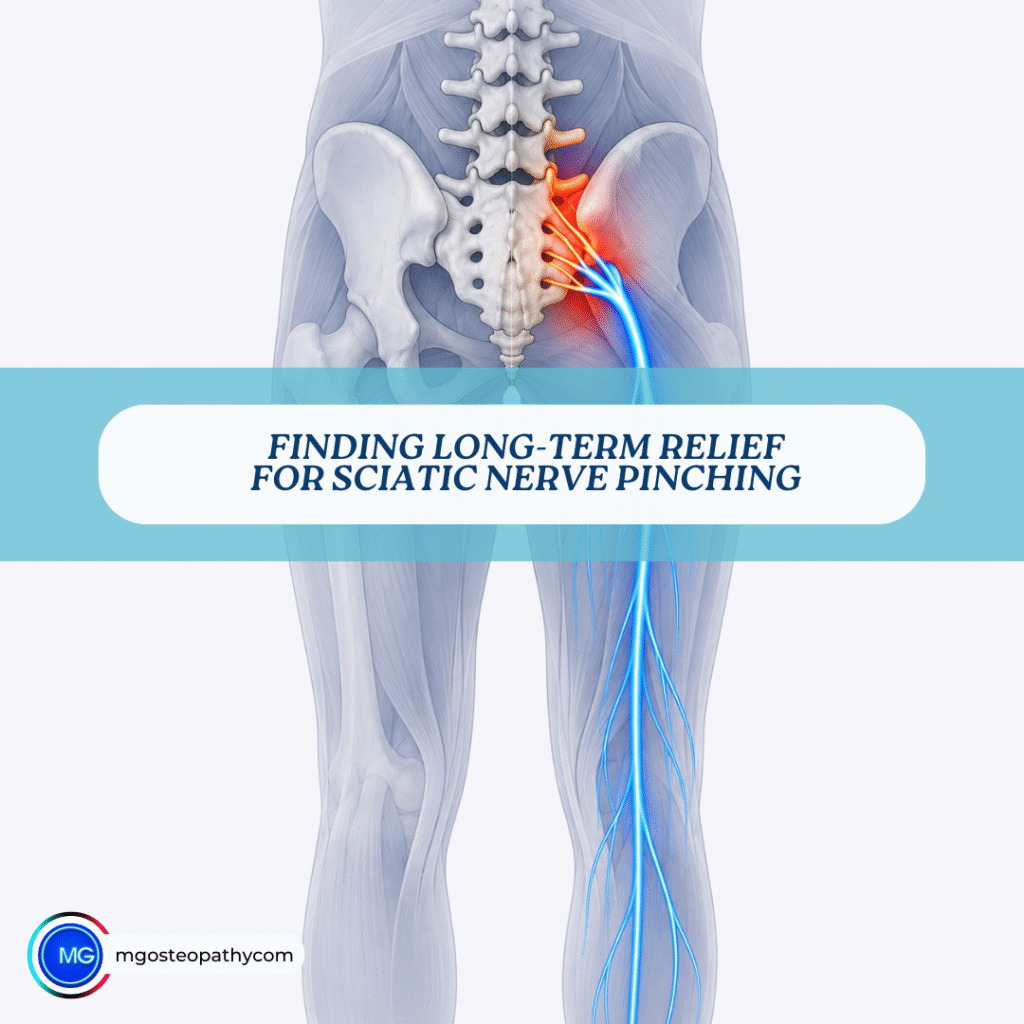
Sciatic nerve pinching is one of those conditions that can completely take over your life. The sharp, burning pain that shoots down your leg, the numbness that makes sitting unbearable, the stiffness that greets you every morning — living with sciatica is exhausting.
For many people, the frustration is not just the pain itself. Sciatica keeps coming back. A flare-up settles, life returns to normal, and then weeks or months later the same symptoms return — often triggered by something as simple as bending down or sitting for too long.
This guide explains what sciatic nerve pinching actually is, why it keeps coming back, and what long-term relief genuinely looks like.
Common Symptoms of Sciatic Nerve Pinching
Sciatic nerve pinching can present differently from person to person. Common symptoms include:
- Sharp, burning, or electric pain running from the lower back into the buttock and leg
- Numbness or tingling in the leg, calf, or foot
- Weakness in the leg, foot, or toes
- Pain that worsens significantly with prolonged sitting
- Symptoms that flare when coughing, sneezing, or straining
- Discomfort that eases temporarily with walking or movement
- Stiffness and aching in the lower back and hip
- Symptoms that are typically worse on one side
If these symptoms are recurring or have persisted for several weeks, professional assessment from a sciatica specialist is strongly recommended.
What Causes Sciatic Nerve Pinching?
Understanding the cause of your sciatic nerve pinching is the single most important step towards finding long-term relief. Without identifying the specific driver, treatment addresses symptoms rather than the problem itself — which is why so many people experience repeated flare-ups despite receiving treatment.
Herniated or Prolapsed Disc
The most common cause of sciatic nerve pinching. When the soft inner material of a lumbar disc pushes through a weakness in its outer casing, it can press directly onto the nearby nerve root. Even a small amount of pressure produces significant pain, numbness, and weakness along the sciatic nerve’s path.
Disc herniations are particularly common at L4-L5 and L5-S1 — precisely where the sciatic nerve roots originate. Furthermore, repetitive bending, heavy lifting, prolonged sitting, and poor movement mechanics all increase the risk of disc herniation over time.
Piriformis Syndrome
The piriformis is a small but significant muscle located deep in the buttock. In many people, the sciatic nerve passes directly beneath it — and in some cases, directly through it. When the piriformis becomes tight, overloaded, or inflamed, it compresses the sciatic nerve and produces symptoms that closely mimic disc-related sciatica.
Piriformis syndrome is frequently overlooked because it does not show up on spinal MRI scans. As a result, patients can undergo spinal treatment for months without addressing the actual cause of their symptoms.
Lumbar Spinal Stenosis
Spinal stenosis occurs when the spinal canal narrows, reducing the space available for the nerve roots. It is more common in people over 50 and often produces sciatica-type symptoms that worsen with walking and standing. Characteristically, symptoms ease when sitting or bending forwards — a pattern that distinguishes stenosis from disc-related sciatica.
Facet Joint Irritation
The facet joints are small paired joints running along the back of the spine. When these become irritated or inflamed — through injury, degeneration, or sustained poor posture — they can refer pain into the buttock and leg in a pattern similar to sciatica. Correctly identifying facet joint involvement is important, as it requires a different treatment approach from disc or nerve-related causes.
Spondylolisthesis
Spondylolisthesis occurs when one vertebra slips forwards over the one below it. This reduces the space available for the nerve roots and can produce persistent sciatica symptoms, particularly during activity or prolonged standing. Mild spondylolisthesis is often manageable conservatively with the right treatment and rehabilitation approach.
Poor Movement Patterns and Muscle Imbalances
Even after the primary cause of nerve pinching has been treated, poor movement patterns and muscle imbalances frequently maintain the problem. Weak glutes, tight hip flexors, reduced lumbar mobility, and inefficient movement mechanics all place continued load through the lumbar spine and surrounding structures — keeping the sciatic nerve under repeated low-level stress.
This is one of the most important and most commonly overlooked reasons why sciatica keeps recurring.
Why Does Sciatica Keep Coming Back?
If your sciatica keeps returning, it is almost always because the underlying cause has not been fully addressed. Treating the acute pain — through medication, rest, or short-term manual therapy — reduces symptoms temporarily. However, without addressing the movement patterns, muscle imbalances, and structural factors that caused the nerve pinching in the first place, the same stresses continue to act on the same structures.
Think of it this way. If you keep spraining your ankle because your balance and ankle strength are poor, treating each sprain individually will never prevent the next one. The same principle applies to sciatica.
Long-term relief requires identifying and correcting the full picture — not just managing each flare-up as it arrives.
How a Sciatica Specialist Approaches Long-Term Relief
At MG Osteopathy in London, our approach to long-term sciatic nerve relief is structured around three phases — thorough assessment, targeted treatment, and progressive rehabilitation.
Phase 1 — Thorough Clinical Assessment
Every patient begins with a detailed assessment designed to identify the specific cause and contributing factors of their sciatica. This includes:
- A full case history covering symptom pattern, triggers, and history
- Postural and movement assessment to identify compensatory patterns
- Neurological testing — straight leg raise, reflex testing, sensation, and strength
- Hands-on palpation of the spine, sacrum, pelvis, piriformis, and surrounding soft tissues
- Review of any relevant scan results in the context of clinical findings
This assessment gives us a clear and specific picture of what is driving your sciatic nerve pinching — and allows us to build a treatment plan that addresses it directly.
Phase 2 — Targeted Hands-On Treatment
With a clear diagnosis in place, hands-on treatment begins. Depending on the cause of your nerve pinching, treatment may include:
- Spinal joint mobilisation to reduce pressure on the affected nerve roots
- Soft tissue and myofascial release around the lumbar spine, piriformis, and gluteal muscles
- Neural mobilisation techniques to improve sciatic nerve movement and reduce sensitivity
- Sacroiliac and pelvic techniques to address load transfer dysfunction through the lower back
- Shockwave therapy for chronic soft tissue restriction or tendon-related contributors
- Sports massage to reduce muscle tension and support recovery between sessions
Each treatment session is adjusted based on your response — with techniques progressing as symptoms settle and movement improves.
Phase 3 — Progressive Rehabilitation
This is the phase that makes the biggest difference to long-term outcomes — and the phase that is most often skipped elsewhere.
Progressive rehabilitation addresses the underlying weakness, movement habits, and lifestyle factors that allowed the pinching of the sciatic nerve to develop and recur. A comprehensive rehabilitation programme typically includes:
- Sciatic nerve glide exercises to reduce nerve sensitivity and restore normal movement
- Deep core stabilisation to reduce load through the lumbar discs and joints
- Glute strengthening to support the pelvis and reduce piriformis irritation
- Hip flexor and hamstring mobility work to improve lumbar mechanics
- Movement pattern retraining for bending, lifting, and everyday activities
- Postural and ergonomic advice tailored to your occupation and daily habits
- Gradual return to exercise, sport, or physical work
The goal of rehabilitation is not simply to get you out of pain. It is to rebuild the strength, mobility, and movement quality that protect your sciatic nerve from repeated pinching going forward.
Self-Management Strategies for Sciatic Nerve Pinching
Alongside clinical treatment, several self-management strategies can support your recovery and reduce the frequency of flare-ups.
- Keep moving — gentle walking remains one of the most effective ways to reduce sciatic nerve sensitivity and maintain circulation through the lumbar spine
- Avoid prolonged sitting — sitting increases disc pressure and can maintain nerve compression. Take regular movement breaks throughout the day
- Sleep position — side sleeping with a pillow between the knees reduces rotational strain through the lower back and often eases overnight symptoms significantly
- Nerve glide exercises — gentle neural mobilisation exercises performed daily reduce nerve sensitivity and improve movement between treatment sessions
- Heat therapy — applying heat to the lower back and buttock helps reduce muscle spasm around the irritated nerve
When Should You See a Sciatica Specialist?
If your sciatica has been present for more than a few weeks, keeps recurring, or is significantly affecting your daily life, seeing a sciatica specialist in London is strongly recommended.
Early, targeted assessment and treatment consistently produce faster recovery and significantly reduce the risk of symptoms becoming chronic. The longer sciatic nerve pinching goes unaddressed, the more entrenched the compensatory movement patterns become — and the longer they take to correct.
Seek prompt medical advice if:
- Leg pain, numbness, or tingling is worsening rather than improving
- Significant weakness is developing in the leg, foot, or toes
- Symptoms came on after a fall, accident, or impact
- Pain is severe and not responding to any self-management measures
Seek urgent medical attention immediately if:
- Do you experience any changes in bladder or bowel function
- Numbness develops in the inner thighs or saddle area
- Both legs are affected simultaneously
These symptoms can indicate cauda equina syndrome — a serious condition requiring emergency medical assessment without delay.
Sciatica Specialist Treatment at MG Osteopathy – Hackney and Islington, London
If you are looking for a sciatica specialist in London, MG Osteopathy offers thorough clinical assessment and effective long-term treatment across Hackney and Islington.
We regularly treat patients with recurring sciatica, disc-related back pain, piriformis syndrome, lumbar nerve irritation, spinal stenosis, and chronic leg pain. Whether you have been managing symptoms for weeks or years, our aim is straightforward — identify exactly what is driving your sciatic nerve pinching, treat it properly, and give you a clear plan to stop it from coming back.
📞 Any questions? Call us: +44 7809 575299
Frequently Asked Questions
How long does it take to find long-term relief from sciatica?
This depends on the cause and how long symptoms have been present. Many patients notice significant improvement within four to six weeks of targeted treatment and rehabilitation. Long-standing or recurrent sciatica typically requires a longer course of treatment, though most patients achieve lasting relief with a structured approach.
Can sciatica be cured permanently?
In most cases, yes — with the right treatment and rehabilitation. The key is addressing the underlying cause rather than simply managing symptoms. Patients who complete a full rehabilitation programme, including strength and movement retraining, have significantly lower rates of recurrence than those who stop at pain relief alone.
Is surgery ever necessary for sciatic nerve pinching?
Surgery is rarely necessary for sciatica. Research consistently shows that conservative treatment — including osteopathy, physiotherapy, and rehabilitation — produces outcomes comparable to surgery for most presentations, without the associated risks and recovery time. Surgery is typically considered only when conservative treatment has been exhausted or when there is significant and progressive neurological deficit.
What makes MG Osteopathy different from other clinics for sciatica treatment?
Our approach goes beyond short-term symptom relief. Every patient receives a thorough assessment, targeted hands-on treatment, and a progressive rehabilitation plan designed to address the specific cause of their sciatica. We treat the whole picture — not just the area that hurts.
📅 Ready to find lasting relief? Contact MG Osteopathy in Hackney and Islington to book your sciatica specialist consultation today.
