
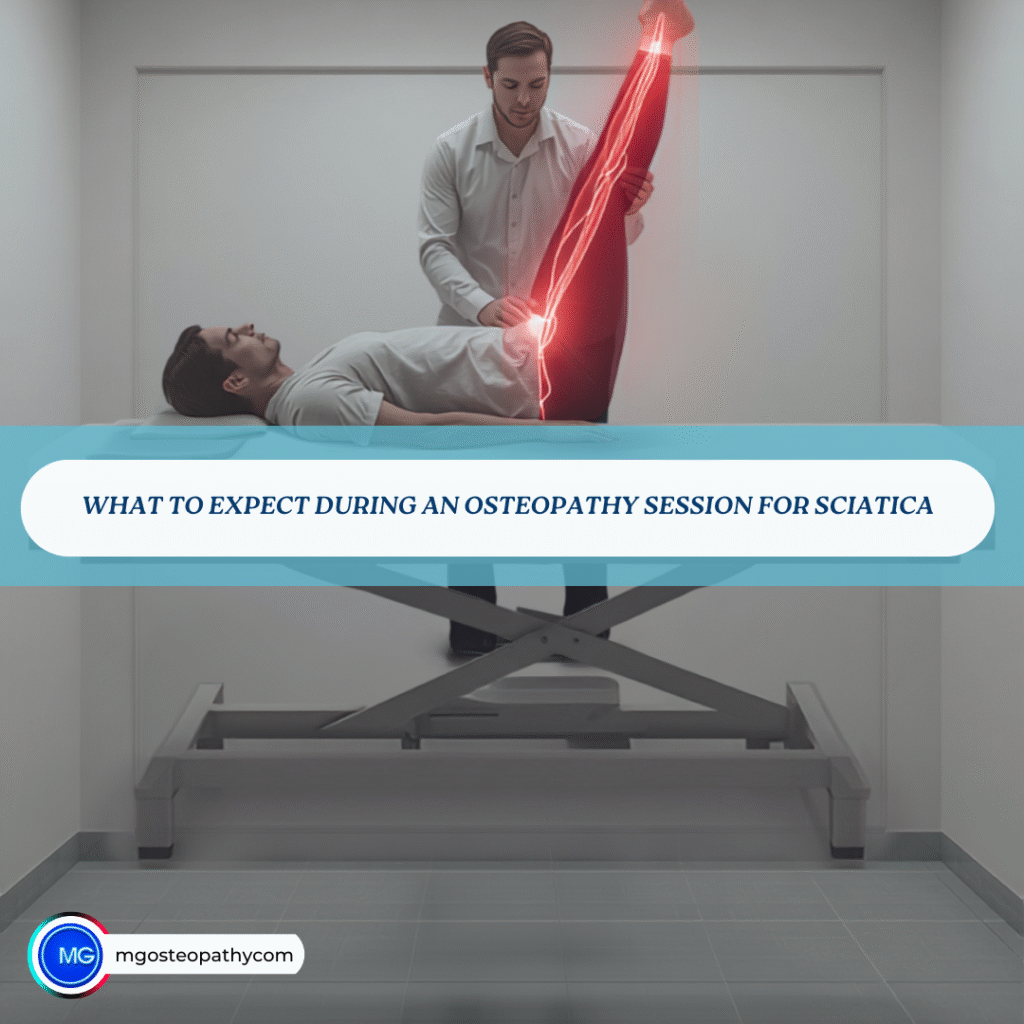
If you have been dealing with sciatica pain and are considering seeing an osteopath for the first time, it is completely natural to have questions. What will they do? Will it hurt? How long will it take? Will one session be enough?
These are questions we hear regularly at MG Osteopathy in Hackney and Islington. Sciatica is one of the most common conditions we treat. In fact, for many patients, an osteopathy session looks and feels quite different from what they expected going in.
Ultimately, this guide walks you through exactly what happens during an osteopathy session for sciatica — from your initial assessment right through to treatment and rehabilitation planning.
Common Sciatica Symptoms Before Your Appointment
First of all, it helps to know whether what you are experiencing is likely to be sciatica. Common symptoms include:
- Sharp, burning, or electric pain travelling from the lower back into the buttock and leg
- Numbness or tingling in the leg, calf, or foot
- Weakness in the leg, foot, or toes
- Pain that worsens with prolonged sitting
- Symptoms that flare when coughing, sneezing, or straining
- Discomfort that eases with gentle walking or movement
- Pain that is typically worse on one side
If these symptoms sound familiar, a sciatica osteopath assessment is a strong and logical starting point.
Before Your Appointment
There is very little preparation required before your first session. Nevertheless, a few things are worth knowing in advance.
What to wear: Wear or bring comfortable, loose-fitting clothing. Since your osteopath will need to assess your spine, hips, and lower limbs, being able to move freely makes the session significantly more effective. Shorts and a vest or sports bra work well.
What to bring: Relevant scan results — such as an MRI or X-ray — are worth bringing along. Although your osteopath will conduct their own clinical assessment regardless, scan results can provide useful additional context.
Step 1 — Your Case History
Every osteopathy session for sciatica begins with a detailed case history. Specifically, your osteopath will ask a series of questions to build a clear picture of your symptoms and what may be driving them.
Questions typically cover:
- Where your pain is and where it travels to
- When symptoms started and what triggered them
- What makes symptoms better or worse
- Your occupation, daily habits, and activity levels
- Any previous back injuries or episodes of sciatica
- Your general health, medication, and relevant medical history
This conversation is not simply box-ticking. Instead, it gives your osteopath crucial information about whether your sciatica is disc-related, piriformis-driven, or linked to another structural issue entirely. As a result, this directly shapes how treatment is approached from the very start — which makes a significant difference to the overall outcome.
Step 2 — Physical Assessment
After taking your case history, your osteopath will carry out a thorough physical assessment. Rather than simply examining the area that hurts, this process looks at how your whole body is moving and functioning together.
Postural Assessment
To begin with, your osteopath will observe how you stand, looking at spinal alignment, pelvic position, and any asymmetries that may contribute to nerve irritation over time.
Movement Assessment
Following this, you will move through a series of positions — bending forwards, backwards, and rotating. This helps your osteopath identify where movement is restricted, painful, or being compensated elsewhere in the body.
Neurological Testing
For sciatica specifically, neurological testing is an essential part of the process. This typically includes:
- Straight leg raise test — assessing nerve root irritation by raising the leg while lying flat
- Reflex testing at the knee and ankle
- Sensation testing along the leg and foot
- Muscle strength testing in the lower limb
Together, these tests help identify which nerve root is affected and how severe the compression may be — giving a much clearer picture than pain location alone.
Hands-On Palpation
Following the movement tests, your osteopath will feel along the spine, sacrum, hips, and surrounding soft tissues. Areas of restriction, muscle spasm, joint stiffness, and tissue tension that may be contributing to your symptoms are all identified at this stage.
Step 3 — Diagnosis and Explanation
Once the assessment is complete, your osteopath will explain clearly what they have found. Although this part of the session is often undervalued by patients, it makes a genuine difference to how well and how quickly you recover.
A thorough explanation covers:
- What is likely causing your sciatica
- Which structures are involved
- Why do your symptoms behave the way they do
- What the treatment plan will involve
- What you can realistically expect in terms of recovery timeline
Research consistently shows that patients who understand their condition respond better to treatment. Furthermore, those who feel informed are significantly less likely to catastrophise their symptoms — which, in itself, speeds up recovery considerably and reduces the risk of symptoms becoming chronic.
Step 4 — Hands-On Treatment
With the assessment complete, your osteopath will move into hands-on treatment. The specific techniques used depend on what was found during assessment and on how acute your symptoms currently are.
Spinal Joint Mobilisation
Gentle, controlled movements applied to restricted segments of the lumbar spine reduce joint stiffness, improve movement, and decrease pressure on the affected nerve roots. Moreover, many sciatica patients notice an immediate improvement in leg symptoms following this technique alone.
Soft Tissue Release
Tight muscles around the lumbar spine, gluteal region, piriformis, and hamstrings commonly go into protective spasm around an irritated nerve. By releasing them, your osteopath reduces compression and, as a result, allows the nerve to move more freely through the surrounding tissue.
Neural Mobilisation
One of the most specific techniques for sciatica, neural mobilisation uses gentle rhythmic movements to improve the ability of the sciatic nerve to slide freely through surrounding tissues. When a nerve has been compressed, it gradually loses some of this mobility. Consequently, restoring it significantly reduces both pain and sensitivity along the full length of the nerve’s path.
Myofascial Release
Slower, sustained techniques target areas of fascial restriction around the lower back, hip, and buttock. Particularly useful for patients with chronic or long-standing sciatica, these approaches address soft tissue restriction that has built up gradually and is now maintaining the nerve irritation.
Sacroiliac and Pelvic Techniques
The sacroiliac joints and pelvis play an important role in load transfer through the lower back. Additionally, dysfunction in this area can contribute directly to sciatic nerve irritation — which is why addressing it forms a key part of effective treatment for many patients.
Step 5 — Rehabilitation Advice and Home Exercises
Hands-on treatment alone is rarely enough to resolve sciatica fully. Before you leave, therefore, your osteopath will give you tailored advice and specific exercises to support your recovery between sessions.
A typical home programme includes:
- Nerve mobilisation exercises to continue reducing sciatic nerve sensitivity at home
- Gentle mobility work for the lumbar spine and hips
- Advice on positions and activities to avoid during the acute phase
- Core activation exercises to reduce load through the affected disc or joint
- Postural and ergonomic advice relevant to your work and daily habits
Rather than being generic, every exercise is chosen specifically for your symptoms, your current stage of recovery, and what was found during your assessment. Consistency between sessions makes a significant difference to the overall speed of recovery.
Will the Treatment Hurt?
This is one of the most common questions patients ask before their first session. The honest answer is — it depends on how acute your symptoms are at the time of treatment.
Hands-on treatment for sciatica should never be aggressively painful. Certain techniques — particularly soft tissue work around the piriformis and gluteal muscles — can feel tender, especially when those areas are in significant spasm. Most patients, however, describe the overall experience as a mix of pressure, mild discomfort, and genuine relief.
After the session, some people feel an immediate improvement, while others notice mild local soreness for 24 to 48 hours before symptoms begin to settle. Both responses are completely normal. Throughout the entire session, your osteopath will always work within your comfort levels and adjust techniques accordingly.
How Many Sessions Will You Need?
Recovery from sciatica varies considerably between individuals. As a general guide:
- Acute sciatica present for a few weeks typically responds well within three to six sessions
- Chronic or long-standing sciatica may need a longer course of treatment and structured rehabilitation
- Patients who engage consistently with their home exercise programme tend to recover faster and experience fewer recurrences overall
Based on what the assessment found, your osteopath will give you a realistic and honest indication of the expected number of sessions at the end of your first appointment.
When Should You Seek Help?
If your sciatica symptoms have been present for more than a few days, are worsening, or are significantly affecting your daily life, early assessment is strongly recommended. Generally speaking, the sooner treatment begins, the faster and more complete the recovery tends to be — and the lower the risk of symptoms becoming long-term.
Seek urgent medical attention immediately if you experience:
- Any changes in bladder or bowel function
- Numbness in the inner thighs or saddle area
- Rapidly worsening weakness in both legs
These symptoms can indicate cauda equina syndrome — a serious condition that requires emergency medical assessment without any delay.
Sciatica Osteopath Treatment at MG Osteopathy – Hackney and Islington, London
If you are looking for a sciatica osteopath in Hackney or Islington, MG Osteopathy offers thorough clinical assessment and effective hands-on treatment to support your recovery fully.
Patients with sciatica, disc-related back pain, piriformis syndrome, lumbar nerve irritation, and chronic leg pain are among those we treat most regularly. From your very first session, our aim is straightforward — to give you a clear understanding of what is driving your symptoms and a structured, realistic plan to resolve them.
📞 Any questions? Call us: +44 7809 575299
Frequently Asked Questions
How long does a sciatica osteopathy session last?
Your first session typically lasts 45 to 60 minutes, since it includes a full assessment alongside hands-on treatment.
Should I see an osteopath or physiotherapist for sciatica?
Both are effective approaches for sciatica. Osteopathy combines hands-on treatment with rehabilitation advice, taking a whole-body approach to the problem. Physiotherapy, on the other hand, places a stronger emphasis on exercise-based rehabilitation from the outset. Ultimately, the right choice depends on your specific symptoms and what is driving them.
Can osteopathy make sciatica worse?
A temporary increase in local soreness for 24 to 48 hours after treatment is normal and not a cause for concern. If your symptoms significantly worsen following a session, however, contact your osteopath promptly for guidance. Treatment is always carefully adjusted based on your individual response.
Do I need a GP referral to see an osteopath for sciatica?
No — you can book directly with MG Osteopathy without a GP referral. As primary healthcare practitioners, osteopaths are fully trained to assess, diagnose, and treat musculoskeletal conditions independently and without a referral from your doctor.
📅 Ready to get assessed? Contact MG Osteopathy in Hackney and Islington to book your sciatica osteopath consultation today.
