
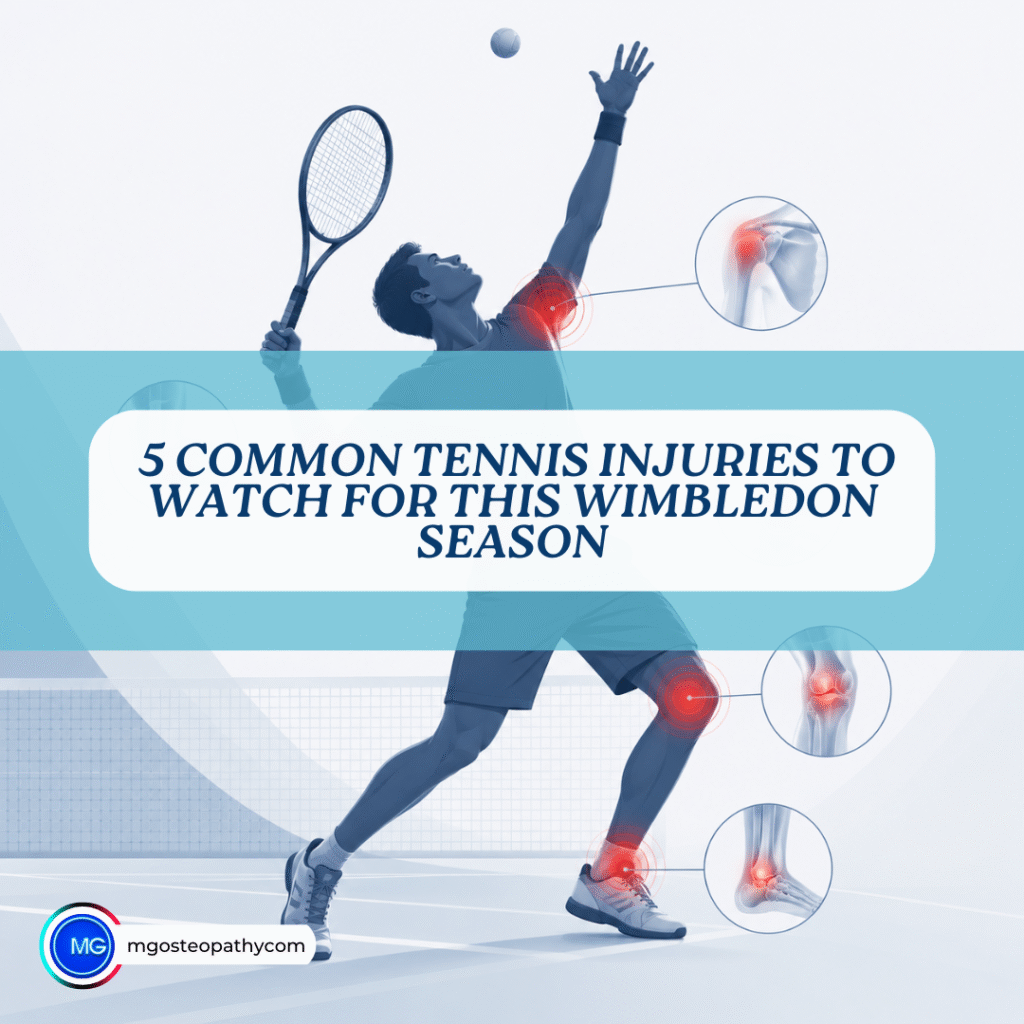
Wimbledon always brings a surge of interest in tennis. Courts across London get busier, club memberships pick up, and plenty of people who have not picked up a racket in months suddenly find themselves back on court.
It is a great time to get active. However, tennis places significant demand on the shoulders, elbows, knees, and lower back. This is especially true if you are returning after a break or playing more often than your body is used to.
At MG Osteopathy in Hackney and Islington, we treat tennis-related injuries regularly during the summer months. This guide covers the five most common injuries we see, what causes them, and how physiotherapy and osteopathy can help you stay on the court.
Common Symptoms to Watch For
Tennis injuries present differently depending on which structure is affected. Common symptoms include:
- Pain or tenderness on the outside or inside of the elbow
- Shoulder pain when serving or reaching overhead
- Lower back stiffness or pain after playing
- Knee pain when changing direction or stopping suddenly
- Ankle pain or swelling following a twist or roll
- Pain that worsens during or shortly after play
- Stiffness that sets in the day after a match
If symptoms persist beyond a few days or worsen with continued play, it is worth getting assessed before returning to court.
1. Tennis Elbow (Lateral Epicondylitis)
Tennis elbow is exactly what it sounds like. Despite the name, it affects far more than just tennis players. It causes pain and tenderness on the outer elbow, often radiating down the forearm.
It develops from repeated strain on the forearm tendons, usually caused by repetitive gripping and, in particular, the backhand stroke. For example, an overly tight grip or an unsuitable racket can increase the load on the elbow.
What helps: Soft tissue release through the forearm, grip and technique advice, and a progressive loading programme for the tendon are all effective. Rest alone is rarely enough — the tendon needs correct loading to recover fully.
2. Rotator Cuff Strain
The serve is one of the most demanding movements in tennis, placing a significant repetitive load on the shoulder. As a result, rotator cuff strain is common among players who serve frequently, especially if shoulder strength and mobility have not been built up gradually.
Symptoms typically include pain when reaching overhead, weakness during serving or smashing, and discomfort that can disturb sleep when lying on the affected side.
What helps: Shoulder mobility work, rotator cuff strengthening, and technique assessment all reduce strain on the joint. Addressing scapular control — how the shoulder blade moves — is often a key part of recovery that gets overlooked.
3. Lower Back Pain from Serving and Rotation
Tennis involves repeated rotation, extension, and explosive movement through the lower back, particularly during the serve. Over time, this repetitive loading can lead to muscle strain, facet joint irritation, and, in some cases, disc-related symptoms.
Players with tight hips, weak core muscles, or poor rotational control through the trunk are particularly susceptible.
What helps: Osteopathic treatment restores spinal mobility. Combined with core stabilisation and hip mobility work, it addresses both the symptoms and the underlying movement pattern causing them.
4. Knee Pain from Lateral Movement
Tennis demands rapid changes of direction, sudden stops, and lateral movement. All of this places a significant load on the knee. Common issues include patellar tendinopathy, general knee strain, and irritation around the kneecap.
This is particularly common in players returning to the sport after time off, when the muscles supporting the knee are not yet conditioned for the demands of the game.
What helps: A structured rehabilitation programme focusing on quad and glute strength, alongside movement retraining for cutting and stopping mechanics, significantly reduces recurrence risk.
5. Ankle Sprains
Ankle sprains are among the most common acute tennis injuries. They usually occur when a player rolls their ankle during quick lateral movement or an awkward landing.
Mild sprains can settle with rest and basic management. However, sprains that are not properly rehabilitated often lead to recurring instability and a higher risk of re-injury.
What helps: Early assessment grades the severity of the sprain. From there, a progressive rehabilitation programme focusing on balance, proprioception, and ankle strength gives the best chance of a full and lasting recovery.
How Physiotherapy and Osteopathy Can Help Tennis Injuries
At MG Osteopathy in Hackney and Islington, we take a thorough approach to assessing and treating tennis injuries. We look beyond the immediate area of pain to understand what is driving it. This could be technique, muscle imbalance, joint restriction, or a previous injury that was never fully rehabilitated.
Treatment typically includes:
- Detailed assessment of movement, strength, and joint mobility
- Soft tissue and manual therapy to reduce pain and restore movement
- Joint mobilisation where restriction is contributing to the problem
- A structured rehabilitation programme tailored to your sport and goals
- Sports massage to support recovery and reduce muscle tension between sessions
- Shockwave therapy for stubborn tendon-related injuries such as tennis elbow
Our goal goes beyond simply getting you out of pain. We aim to get you back on court with a lower risk of the injury returning.
When Should You Seek Help?
Minor aches after a match are common and often settle with rest. However, you should get assessed if pain persists for more than a few days, worsens with continued play, or affects your ability to perform everyday tasks such as gripping, lifting, or walking.
Getting an early assessment prevents a minor strain from developing into a longer-term problem. It also gets you back to tennis faster.
Tennis Injury Treatment at MG Osteopathy – Hackney and Islington, London
If you are dealing with a tennis injury this Wimbledon season, MG Osteopathy offers thorough assessment and effective treatment across Hackney and Islington. We regularly treat tennis players and recreational athletes with tennis elbow, shoulder strain, lower back pain, knee injuries, and ankle sprains.
Whether you are a regular club player or have just picked up a racket for the first time in years, our aim stays the same — to get you out of pain and back on court with confidence.
📞 Any questions? Call us: +44 7809 575299
Frequently Asked Questions
How long does tennis elbow take to heal?
Most cases improve within six to twelve weeks with appropriate treatment and a progressive loading programme. Chronic or long-standing tennis elbow can take longer, particularly if technique and grip factors are not addressed alongside treatment.
Can I keep playing tennis with a minor injury?
This depends on the injury and its severity. Some mild strains can be managed alongside modified play, while others require a period of rest to avoid worsening the problem. A clinical assessment will give you a clear answer specific to your injury.
Do I need to be a competitive player to get a tennis injury?
No. Recreational and social players are just as susceptible to tennis injuries as competitive athletes, often more so, due to less consistent conditioning, technique, and warm-up habits.
Should I see a physiotherapist or osteopath for a tennis injury?
Both are effective for tennis-related injuries. Physiotherapy tends to focus more heavily on exercise-based rehabilitation, while osteopathy takes a broader, whole-body approach. The right choice often depends on your specific injury and goals.
📅 Ready to get back on court? Contact MG Osteopathy in Hackney and Islington to book your assessment today.
