
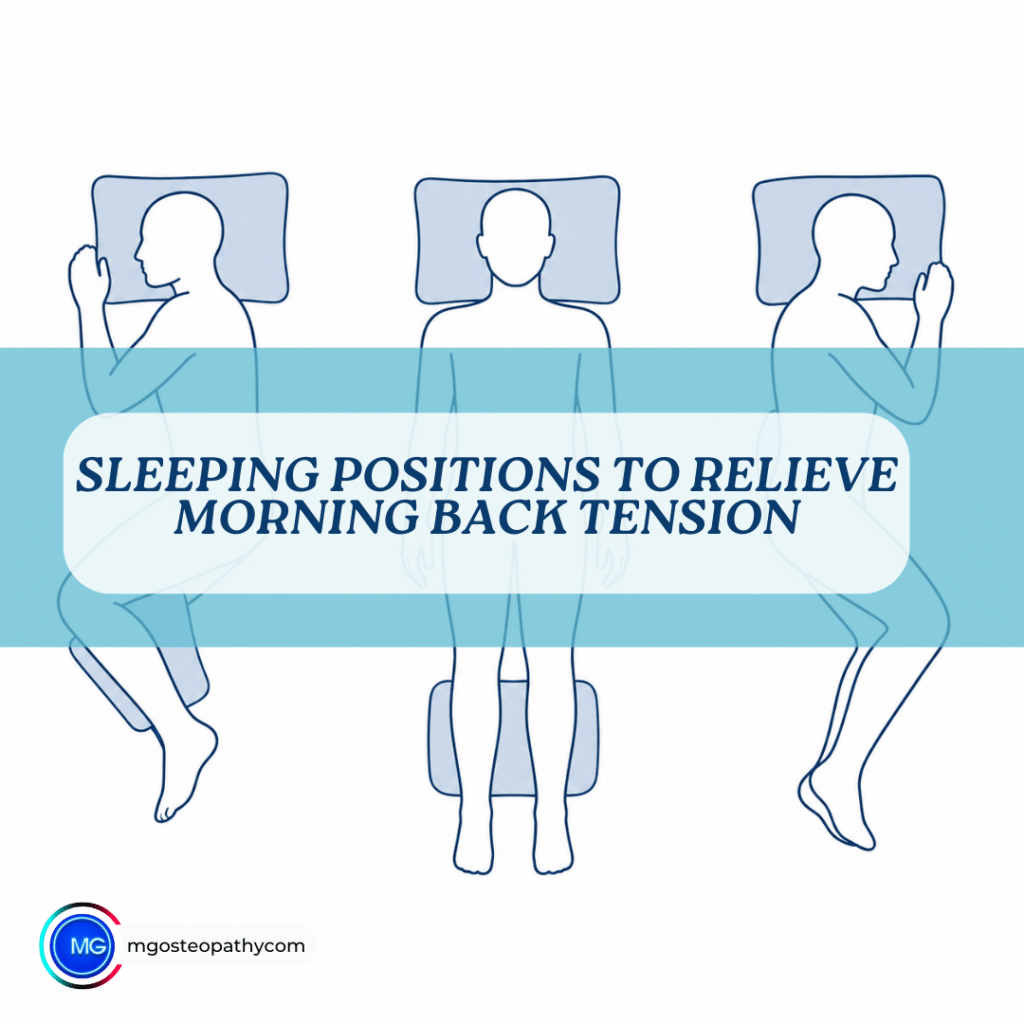
Waking up with stiff, aching back pain is more common than most people realise. For many, it is simply part of the morning routine — roll out of bed, wait for the stiffness to ease, and get on with the day. But morning back tension is not something you have to accept. The position you sleep in has a direct impact on your lower back. A good sleeping position allows your spine to rest in a neutral alignment throughout the night. A poor posture places sustained pressure on the lumbar joints, discs, and surrounding muscles for hours at a time.
At MG Osteopathy in Hackney and Islington, we regularly see patients whose morning back pain is significantly influenced by how they sleep. The right adjustments can make a real difference — often without any other changes at all.
Common Symptoms of Morning Back Tension
Morning back tension can feel different from person to person. Common symptoms include:
- Stiffness and achiness across the lower back on waking
- Pain or tightness that takes 20 to 30 minutes to ease
- Discomfort when rolling over or getting out of bed
- A deep, dull ache through the lumbar spine or hips
- Tightness through the glutes or upper back on waking
- Symptoms that improve once you start moving
If your back pain is consistently worse first thing in the morning and eases as the day progresses, your sleeping position is very likely a contributing factor.
Why Does Sleep Position Affect Your Back?
Your spine is supported by muscles, joints, discs, and ligaments that all need to rest in a balanced position overnight. When your sleeping position pulls the spine out of neutral alignment, these structures are placed under low-level but sustained strain for six to eight hours at a time.
Over a single night, this may not cause significant problems. But over weeks and months, it creates cumulative strain that shows up as morning stiffness, recurring aches, and gradually worsening back tension.
Your mattress and pillow also play a role. However, position is often the more immediate factor — and it is one you can change tonight.
3 Sleeping Positions to Relieve Morning Back Tension
Position 1 — On Your Side With a Pillow Between Your Knees
Sleeping on your side is one of the most comfortable and spine-friendly positions for most people. However, without support between the knees, the top leg drops forward and rotates the pelvis. This places a twisting strain through the lower back that builds throughout the night.
The fix is simple. Place a firm pillow between your knees to keep your hips, pelvis, and spine in neutral alignment. This small change reduces rotational strain through the lumbar spine and takes pressure off the lower back muscles and joints.
This position works particularly well for:
- Lower back pain and stiffness
- Hip and pelvic pain
- Sciatica and disc-related symptoms
- Pregnant women and those with pelvic girdle pain
Tips for getting it right:
- Use a firm pillow rather than a soft one — it needs to maintain the gap between your knees
- Keep your knees slightly bent rather than fully straight
- Avoid curling too tightly into the foetal position, as this can increase pressure on the lumbar discs
Position 2 — On Your Back With a Pillow Under Your Knees
Sleeping on your back is widely considered the most neutral position for spinal alignment. It distributes your body weight evenly and allows the lumbar spine to rest without rotation or sideways bending.
However, lying flat on your back without any support can allow the lower back to arch away from the mattress. This increases extension through the lumbar spine and can aggravate facet joint irritation and muscle tension.
The fix is to place one or two pillows under your knees. This gently flattens the lower back towards the mattress, reduces lumbar extension, and takes pressure off the facet joints and surrounding muscles.
This position works particularly well for:
- Facet joint pain and lumbar stiffness
- General lower back aching
- Those recovering from a disc injury
- People who find side sleeping uncomfortable
Tips for getting it right:
- Use enough pillow height to feel a gentle reduction in lower back tension — it should feel immediately more comfortable
- Keep your head supported with a pillow that maintains a neutral neck position
- Avoid sleeping with your arms raised above your head, as this can increase upper back and shoulder tension
Position 3 — Modified Side Position With a Pillow Supporting the Waist
For some people — particularly those with a wider hip-to-waist ratio — side sleeping still leaves a gap between the waist and the mattress. This causes the lumbar spine to sag slightly sideways throughout the night, creating a lateral strain through the lower back muscles and joints.
The fix is to place a small, firm pillow or rolled towel beneath the waist when lying on your side. This fills the gap between the body and the mattress, supports the lumbar curve, and keeps the spine in a straighter, more neutral alignment.
This position works particularly well for:
- Lateral lower back pain and side-dominant stiffness
- Hip pain when side sleeping
- Those whose mattress feels too firm or uneven
Tips for getting it right:
- The support should be firm enough to fill the gap without pushing the spine upwards
- Combine this with a pillow between the knees for maximum lumbar support
- Experiment with the thickness of the support — too much can push the spine into lateral flexion the other way
Sleeping Positions to Avoid With Back Pain
Some positions consistently increase strain through the lower back and are worth avoiding if morning stiffness is a problem.
Sleeping on your stomach is one of the most problematic positions for lower back health. It forces the lumbar spine into sustained extension and requires the neck to rotate to one side for several hours. This places significant strain on the lower back, hips, and cervical spine simultaneously. If you find it difficult to break the habit, placing a pillow under your pelvis can slightly reduce lumbar extension.
Sleeping in a twisted or asymmetrical position — such as with one leg pulled up and the other straight — creates a rotational strain through the pelvis and lower back that builds throughout the night.
How Osteopathy and Physiotherapy Can Help Morning Back Pain
Adjusting your sleeping position is a useful self-management strategy. However, if your morning back tension is persistent, recurring, or worsening, it is worth getting a proper clinical assessment.
At MG Osteopathy in Hackney and Islington, we assess the full picture — your spinal mobility, muscle balance, joint restriction, movement patterns, and lifestyle factors, including sleep habits. Treatment may include:
- Joint mobilisation to restore movement to restricted lumbar segments
- Soft tissue and myofascial release to reduce overnight muscle tension
- Targeted rehabilitation exercises to address underlying weakness
- Postural and sleep position advice tailored to your specific symptoms
- Shockwave therapy for stubborn areas of chronic soft tissue restriction
Every treatment plan is built around your individual symptoms, habits, and goals.
When Should You Seek Help for Morning Back Pain?
If your morning back stiffness has been present for more than a few weeks, is getting progressively worse, or is not improving despite adjusting your sleep position, a clinical assessment is strongly recommended.
Seek prompt medical advice if your morning back pain is accompanied by:
- Pain, numbness, or tingling traveling into the leg or foot
- Stiffness that takes more than an hour to ease in the morning — this can sometimes indicate an inflammatory condition
- Symptoms that came on after a fall or injury
- Unexplained fatigue or weight loss
Morning Back Pain Treatment at MG Osteopathy – Hackney and Islington, London
If morning back tension is affecting your sleep and your day, MG Osteopathy offers thorough assessment and effective treatment across Hackney and Islington. We regularly help patients with lower back pain, lumbar stiffness, disc-related problems, hip and pelvic pain, and sleep-related back tension.
Our aim is simple — reduce your pain, restore your movement, and give you practical tools to stop it coming back.
📞 Any questions? Call us: +44 7809 575299
Frequently Asked Questions
Can my sleeping position really cause lower back pain?
Yes. A poor sleeping position places sustained strain on the lumbar spine for several hours each night. Over time, this contributes significantly to morning stiffness, recurring aches, and lower back tension that is slow to ease.
What is the best sleeping position for lower back pain?
Side sleeping with a pillow between the knees or back sleeping with a pillow under the knees are generally the most spine-friendly positions. The best option depends on your specific symptoms and what feels most comfortable for your body.
Could my mattress be causing my morning back pain?
A mattress that is too soft or too firm can contribute to morning back pain. However, sleeping position is often the more immediate factor and is worth addressing first. If symptoms persist despite good sleep position habits, a mattress assessment may be worthwhile.
📅 Ready to get assessed? Contact MG Osteopathy in Hackney and Islington to book your consultation.
