
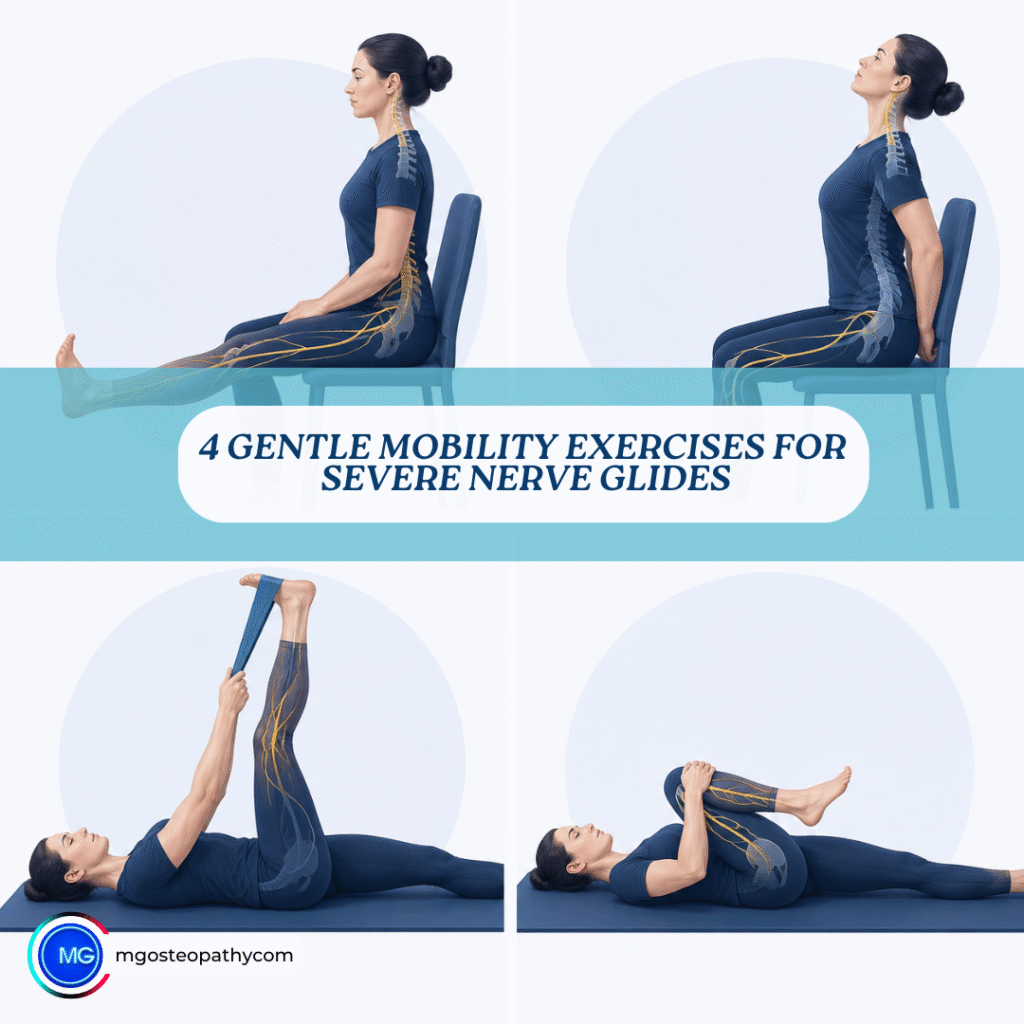
Sciatica pain can make even the simplest movements feel daunting. When pain is shooting down your leg, the last thing you want to do is exercise. However, gentle movement — done correctly — is one of the most effective ways to reduce sciatic nerve irritation and begin the recovery process.
Nerve glide exercises, also known as neural mobilisation or neural flossing, are specifically designed to improve the ability of the sciatic nerve to move freely through the surrounding tissues. When the sciatic nerve has been compressed or irritated, it loses some of its mobility. As a result, everyday movements — sitting, bending, walking — become painful and restricted.
Before You Start — Important Guidelines
These exercises are designed for people managing sciatica symptoms. Before beginning, however, there are a few important points to keep in mind.
Start gently: Nerve glides should never be forced. The goal is to create gentle movement through the nerve — not to stretch it aggressively. If an exercise significantly increases your leg pain or numbness, stop immediately and seek clinical advice.
Consistency matters more than intensity: Short, regular sessions produce better results than infrequent, intense ones. Aim for two to three short sessions per day rather than one long session.
These exercises complement treatment — they do not replace it: If your sciatica is severe, worsening, or has been present for several weeks, a clinical assessment from a qualified osteopath or physiotherapist should come first.
Seek urgent medical attention if you experience:
- Any changes in bladder or bowel function
- Numbness in the inner thighs or saddle area
- Rapidly worsening weakness in both legs
These symptoms can indicate cauda equina syndrome — a serious condition requiring immediate medical assessment.
What Are Nerve Glides and Why Do They Help?
To understand why nerve glides work, it helps to understand what happens to the sciatic nerve during compression or irritation.
The sciatic nerve is not a rigid structure. Under normal circumstances, it slides and glides through the surrounding soft tissues as you move — extending when you bend forwards and relaxing when you sit or flex the knee. When the nerve becomes compressed or inflamed, this movement is restricted. Scar tissue, muscle spasm, and fascial tension can all limit the nerve’s ability to move freely.
Nerve glide exercises restore this movement gradually and safely. Rather than statically stretching the nerve — which can aggravate symptoms — nerve glides create a gentle pumping motion that encourages the nerve to slide through the surrounding tissues. This reduces nerve sensitivity, improves circulation around the nerve, and gradually restores normal movement.
The result, over time, is less pain, less tingling, and a gradual return to normal function.
Exercise 1 — Supine Sciatic Nerve Glide (Lying Down)
This is the gentlest starting point for most sciatica patients. It is performed lying on your back, making it ideal during acute or more painful phases.
Starting position:
Lie flat on your back with both knees bent and feet flat on the floor.
The movement:
- Bring one knee up towards your chest, holding behind the thigh with both hands
- Slowly straighten the knee as much as is comfortable — you should feel a gentle pull or tension, not sharp pain
- As you straighten the knee, gently flex your foot towards you — pulling your toes towards your shin
- Hold for one to two seconds at the end range
- Then bend the knee back towards your chest and point your toes away simultaneously
- Repeat this alternating movement rhythmically for 10 to 15 repetitions
- Perform on both sides, starting with the less affected leg
What you should feel:
A gentle pulling sensation along the back of the thigh or calf is normal. Sharp, electric, or significantly worsening leg pain is not — stop if this occurs.
Sets and repetitions:
Two to three sets of 10 to 15 repetitions, two to three times per day.
Exercise 2 — Seated Sciatic Nerve Glide (Chair)
This exercise is particularly useful for desk workers and those who spend long periods sitting. It can be performed discreetly at a desk or table throughout the working day.
Starting position:
Sit upright on a chair with both feet flat on the floor and your spine in a neutral, supported position.
The movement:
- Slowly straighten one leg out in front of you until you feel a gentle tension in the back of the thigh or leg
- Simultaneously flex your foot — pulling your toes towards your shin — to increase the gentle nerve tension
- Hold for one to two seconds
- Then lower the foot back to the floor and relax
- Alternatively, combine the leg straightening with a gentle chin tuck — nodding your head slightly forwards as you extend the leg — to create a longer nerve glide through the full length of the sciatic nerve
What you should feel:
A gentle stretch or pulling sensation along the back of the leg. This exercise should feel controlled and manageable rather than intense or painful.
Sets and repetitions:
Two to three sets of 10 to 15 repetitions on each side, two to three times per day.
Exercise 3 — Sciatic Nerve Floss (Lying Down)
This exercise introduces a more dynamic nerve flossing technique. Unlike the previous two exercises — which glide the nerve from one end — nerve flossing moves tension alternately between both ends of the nerve simultaneously. This creates a more effective pumping action through the full length of the sciatic nerve.
Starting position:
Lie flat on your back with both knees bent and feet flat on the floor.
The movement:
- Bring one knee up towards your chest, holding behind the thigh
- Begin with the knee slightly bent and the foot relaxed
- Simultaneously extend the knee to straighten the leg while flexing the foot towards you AND gently extend your neck — looking slightly upwards
- Then reverse the movement — bend the knee back towards your chest, point your toes away, and gently tuck your chin towards your chest
- The two ends of the nerve move in opposite directions simultaneously, creating the flossing effect
- Perform this rhythmically and smoothly, without holding at either end
What you should feel:
This exercise creates a slightly stronger sensation than the previous two. A pulling sensation through the back of the leg and into the calf is normal. However, if sharp pain or significantly increased symptoms occur, return to Exercise 1 and progress more gradually.
Sets and repetitions:
Two to three sets of 10 repetitions on each side, once or twice per day initially. Progress to twice daily as symptoms allow.
Exercise 4 — Piriformis Release with Nerve Glide
The piriformis muscle sits deep in the buttock, directly alongside the sciatic nerve. When tight or in spasm — as is common in piriformis syndrome — it compresses the nerve and maintains sciatic symptoms. This exercise combines a gentle piriformis release with a sciatic nerve glide, making it particularly effective for patients whose sciatica originates in the buttock rather than the spine.
Starting position:
Lie flat on your back with both knees bent and feet flat on the floor.
The movement:
- Cross the affected leg over the opposite knee, resting the ankle just above the knee — this creates a figure-four position
- Gently pull the uncrossed leg towards your chest by holding behind the thigh — you should feel a stretch deep in the buttock of the crossed leg
- From this position, slowly straighten and bend the lower leg rhythmically — creating a gentle nerve glide while the piriformis remains in a released position
- Perform 10 to 12 slow, controlled repetitions
- Release and repeat on the other side if symptoms are bilateral
What you should feel:
A deep stretch through the buttock of the crossed leg, combined with a gentle pulling sensation along the back of the lower leg. This exercise often produces noticeable relief of buttock and leg symptoms when performed consistently.
Sets and repetitions:
Two sets of 10 to 12 repetitions on each side, once to twice per day.
How to Progress These Exercises Safely
Starting gently and progressing gradually is the key to getting the most from nerve glide exercises without aggravating your symptoms.
In the first week: Focus on Exercises 1 and 2 only. Keep repetitions low and prioritise consistency over intensity. Two short sessions per day is sufficient to begin with.
In the second week: If symptoms are settling and exercises feel manageable, introduce Exercise 3. At this stage, increasing repetitions gradually is appropriate.
In the third week onwards: Add Exercise 4 if buttock tightness or piriformis irritation is a feature of your symptoms. Continue progressing repetitions and frequency based on how your symptoms respond.
If symptoms worsen at any stage, reduce the intensity and range of movement rather than stopping entirely. Gentle, reduced-range nerve gliding is almost always better than complete rest.
How Osteopathy and Physiotherapy Support Sciatica Recovery
Nerve glide exercises are a valuable self-management tool. However, they work best as part of a broader treatment and rehabilitation plan rather than in isolation.
At MG Osteopathy in Hackney and Islington, we combine nerve glide exercises with hands-on treatment to produce faster and more lasting results. Treatment alongside rehabilitation typically includes:
- Spinal joint mobilisation to reduce pressure on the affected nerve roots
- Soft tissue release around the lumbar spine, piriformis, and gluteal muscles
- Core stabilisation exercises to reduce load through the lumbar discs
- Glute and hip strengthening to support the pelvis and reduce nerve compression
- Postural and ergonomic advice to address contributing lifestyle factors
- Shockwave therapy where chronic soft tissue restriction is maintaining symptoms
Together, these approaches address both the symptoms and the underlying cause — giving you the best chance of a full and lasting recovery.
When Should You Seek Professional Help?
If your sciatica symptoms have been present for more than a few weeks, are worsening despite exercise, or are significantly affecting your sleep, work, or daily activities, a clinical assessment is strongly recommended.
Furthermore, nerve glide exercises alone are unlikely to resolve sciatica driven by a significant disc herniation, spinal stenosis, or complex soft tissue restriction without additional hands-on treatment and structured rehabilitation.
Early assessment consistently produces faster and more complete recovery — and reduces the risk of symptoms becoming chronic.
Sciatica Exercise Support at MG Osteopathy – Hackney and Islington, London
If you are looking for expert guidance on sciatica exercises in Hackney or Islington, MG Osteopathy offers thorough clinical assessment and personalised rehabilitation support to help you recover effectively.
We regularly help patients with sciatica, disc-related back pain, piriformis syndrome, lumbar nerve irritation, and chronic leg pain. Whether you are just beginning your recovery or have been managing symptoms for months, our team will give you a clear and structured plan to get you moving freely again.
📞 Any questions? Call us: +44 7809 575299
Frequently Asked Questions
Are nerve glide exercises safe for severe sciatica?
Nerve glide exercises are generally safe for most sciatica presentations when performed gently and within a comfortable range. However, if your symptoms are severe, rapidly worsening, or accompanied by significant leg weakness, a clinical assessment should come before beginning any exercise programme.
How long does it take for nerve glide exercises to work?
Most people notice some improvement in symptoms within two to four weeks of consistent daily practice. Combined with hands-on treatment from an osteopath or physiotherapist, results are typically faster and more significant than exercise alone.
Can I do these exercises during a sciatica flare-up?
Yes, with caution. During an acute flare-up, reduce the range of movement and keep repetitions low. Gentle nerve gliding during a flare-up can actually help reduce nerve sensitivity and ease symptoms faster than complete rest.
How often should I do sciatica nerve glide exercises?
Two to three short sessions per day produces better results than one longer session. Consistency is far more important than intensity — particularly in the early stages of recovery.
📅 Ready to get assessed? Contact MG Osteopathy in Hackney and Islington to book your sciatica consultation today.
