
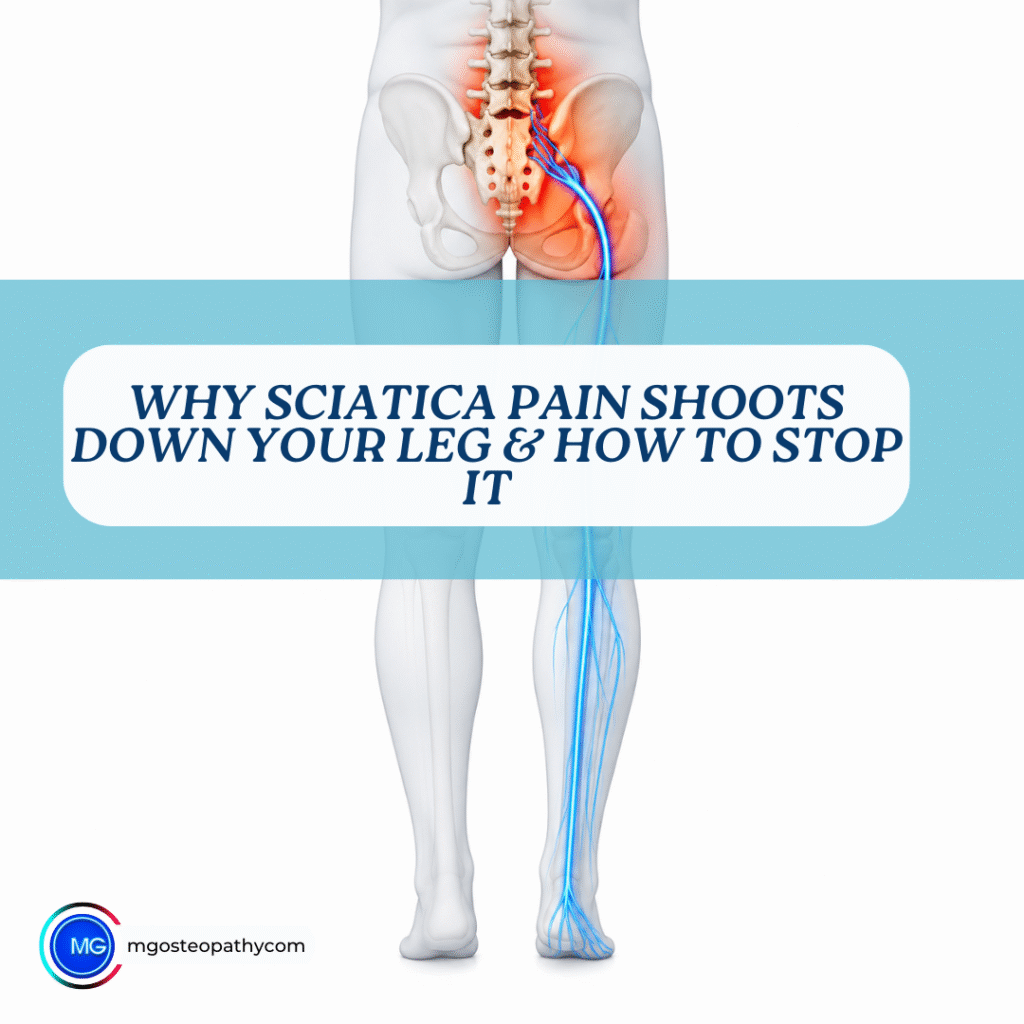
That sharp, burning, or electric pain that travels from your lower back down through your buttock and into your leg — sciatica pain is one of the most recognisable and debilitating forms of back pain. For some people, it comes on suddenly. For others, it builds gradually over weeks or months. Either way, when sciatica pain takes hold, it can make sitting, standing, walking, and sleeping genuinely difficult.
At MG Osteopathy in Hackney and Islington, sciatica is one of the most common conditions we treat. The good news is that most cases respond well to the right conservative treatment — and surgery is rarely necessary.
This guide explains what sciatica actually is, why the pain travels down the leg, what causes it, and what you can do to get lasting sciatica pain relief.
Common Symptoms of Sciatica
Sciatica symptoms can vary significantly between individuals. Common symptoms include:
- Sharp, burning, or electric pain travelling from the lower back into the buttock and leg
- Pain that follows a line down the back or side of the leg
- Numbness or tingling in the leg, calf, or foot
- Weakness in the leg, foot, or toes
- Pain that worsens when sitting for long periods
- Symptoms that flare up when coughing, sneezing, or straining
- Discomfort that eases when walking or lying in certain positions
- Pain that affects one leg more than the other
Sciatica symptoms are usually felt on one side only. If you are experiencing symptoms in both legs simultaneously, seek prompt medical assessment.
Why Does Sciatica Pain Travel Down the Leg?
To understand sciatica, it helps to understand the sciatic nerve itself.
The sciatic nerve is the longest and widest nerve in the human body. It originates from several nerve roots in the lower lumbar spine — typically L4, L5, and S1 — and travels through the buttock, down the back of the thigh, and into the lower leg and foot.
When something irritates or compresses one of these nerve roots, the pain does not stay local. Instead, it travels along the path of the nerve, which is why you feel it in your buttock, thigh, calf, or foot rather than just in your lower back.
This travelling pain is called referred pain or radiculopathy. It is the nerve itself signalling distress along its entire length, not a separate injury in the leg.
What Causes Sciatica?
Sciatica is a symptom rather than a diagnosis in itself. It is always caused by something irritating or compressing the sciatic nerve or its roots. Several conditions can be responsible.
Herniated or Prolapsed Disc
This is the most common cause of sciatica. When the soft inner material of an intervertebral disc pushes through a weakness in the outer casing, it can press directly onto the nearby nerve root. Even a small amount of pressure on a spinal nerve produces significant pain, numbness, and weakness along the nerve’s path.
Disc herniations are particularly common at L4-L5 and L5-S1 — the exact levels where the sciatic nerve roots originate.
Lumbar Spinal Stenosis
Spinal stenosis occurs when the spinal canal narrows and places pressure on the nerve roots within it. It is more common in people over 50 and often produces sciatica-type symptoms that worsen when walking or standing and ease when sitting or bending forward.
Piriformis Syndrome
The piriformis is a small muscle located deep in the buttocks. In some people, the sciatic nerve runs through or directly beneath this muscle. When the piriformis becomes tight or inflamed — through prolonged sitting, overuse, or injury — it can compress the sciatic nerve directly.
This is sometimes called piriformis syndrome and is an important cause of sciatica-type symptoms that does not originate from the spine at all.
Spondylolisthesis
Spondylolisthesis occurs when one vertebra slips forward over the one below it. This can narrow the space available for the nerve roots and produce sciatica symptoms, particularly with activity or prolonged standing.
Degenerative Disc Disease
As the intervertebral discs lose height and hydration over time, the spaces through which the nerve roots exit the spine can narrow. This can place gradual pressure on the sciatic nerve roots and produce chronic or intermittent sciatica symptoms.
How Osteopathy and Physiotherapy Provide Sciatica Pain Relief
At MG Osteopathy in Hackney, Islington, we take a thorough, whole-body approach to assessing and treating sciatica. We identify the specific cause of your nerve irritation and build a treatment plan around it — rather than applying a generic approach to every patient.
Assessment
Every patient begins with a detailed clinical assessment. We examine your spinal mobility, nerve function, muscle strength, and movement patterns to identify exactly where the nerve is being irritated and what is maintaining the problem.
This is an important step. Sciatica from a herniated disc requires a different approach to sciatica from piriformis syndrome — and getting this right from the start produces significantly better outcomes.
Manual Therapy
Hands-on treatment for sciatica may include:
- Spinal joint mobilisation to reduce pressure on the affected nerve roots
- Soft tissue release around the lumbar spine, buttocks, and hip
- Piriformis and deep hip muscle release techniques
- Neural mobilisation — gentle techniques to improve the movement and reduce sensitivity of the sciatic nerve itself
- Myofascial release to address areas of chronic soft tissue restriction
These techniques work together to reduce nerve compression, decrease inflammation, and restore normal movement through the spine and pelvis.
Rehabilitation and Exercise
Rehabilitation is a critical part of long-term sciatica pain relief. Without addressing the underlying weakness and movement habits that contributed to the problem, symptoms are likely to return.
A sciatica rehabilitation programme typically includes:
- Nerve mobilisation exercises to reduce sciatic nerve sensitivity
- Core stabilisation to reduce load through the lumbar discs and joints
- Glute and hip strengthening to support the pelvis and reduce piriformis irritation
- Hip flexor mobility work to reduce lumbar compression
- Gradual return to activity, exercise, and sport
Shockwave Therapy
For patients with chronic sciatica driven by soft tissue restriction — particularly piriformis syndrome or persistent gluteal tightness — shockwave therapy can be a highly effective addition to treatment. It reduces chronic muscle tension, stimulates tissue repair, and improves circulation to areas that have not responded to manual therapy alone.
Sports Massage
Regular sports massage targeting the lumbar spine, gluteal muscles, piriformis, and hamstrings can significantly reduce the muscle tension that contributes to sciatic nerve compression. It works well alongside osteopathy or physiotherapy sessions as part of a comprehensive treatment plan.
Self-Management Tips for Sciatica Pain Relief
Alongside clinical treatment, there are several things you can do at home to manage sciatica symptoms:
- Keep moving — gentle walking is one of the most effective ways to reduce sciatic nerve irritation. Avoid complete rest where possible
- Avoid prolonged sitting — sitting increases pressure on the lumbar discs and can aggravate nerve compression. Take regular movement breaks
- Sleep position — lying on your side with a pillow between your knees reduces rotational strain through the lower back and can ease overnight symptoms
- Avoid bending and twisting during flare-ups, particularly combined movements such as bending forward while rotating
- Apply heat to the lower back and buttocks to reduce muscle spasm around the irritated nerve
When Should You Seek Help for Sciatica?
If you have leg pain, numbness, or tingling that has been present for more than a few days, a clinical assessment is strongly recommended. Early treatment produces faster recovery and reduces the risk of symptoms becoming chronic.
Seek prompt medical advice if:
- Your leg pain or numbness is worsening rather than improving
- You have a significant weakness in the leg, foot, or toes
- Symptoms came on after a fall, accident, or impact
- Your pain is severe and not responding to any self-management measures
Seek urgent medical attention immediately if:
- You experience any changes in bladder or bowel function
- You have numbness in the inner thighs, groin, or saddle area
- Both legs are affected simultaneously
These symptoms can indicate cauda equina syndrome — a serious condition requiring emergency medical assessment.
Sciatica Pain Relief at MG Osteopathy – Hackney and Islington, London
If you are looking for sciatica pain relief in Hackney or Islington, MG Osteopathy offers thorough clinical assessment and effective non-surgical treatment to help you recover.
We regularly treat patients with sciatica, disc-related back pain, piriformis syndrome, lumbar nerve irritation, and chronic leg pain. Whether your symptoms came on suddenly or have been building for months, we will identify what is driving them and give you a clear, structured plan to resolve them.
📞 Any questions? Call us: +44 7809 575299
Frequently Asked Questions
How long does sciatica take to go away?
Most cases of sciatica pain improve significantly within six to twelve weeks with the right treatment and rehabilitation. However, this depends on the cause and how long symptoms have been present. Early assessment and treatment consistently produce faster, more complete recovery.
Can sciatica go away on its own?
Mild sciatica can sometimes settle without treatment. However, symptoms that have been present for more than a few weeks, are worsening, or are significantly affecting daily life, benefit greatly from clinical assessment and treatment. Left unmanaged, sciatica can become chronic and more difficult to resolve.
Is walking good for sciatica?
Generally yes. Gentle walking encourages movement through the spine and pelvis, reduces nerve sensitivity, and maintains circulation to the affected tissues. It is one of the most consistently recommended forms of activity for sciatica recovery.
What is the difference between sciatica and general back pain?
General back pain stays local to the back. Sciatica specifically involves pain, numbness, or tingling that travels from the lower back into the buttock and down the leg — following the path of the sciatic nerve. This travelling symptom pattern is the key distinguishing feature.
📅 Ready to get assessed? Contact MG Osteopathy in Hackney and Islington to book your sciatica assessment today.


