
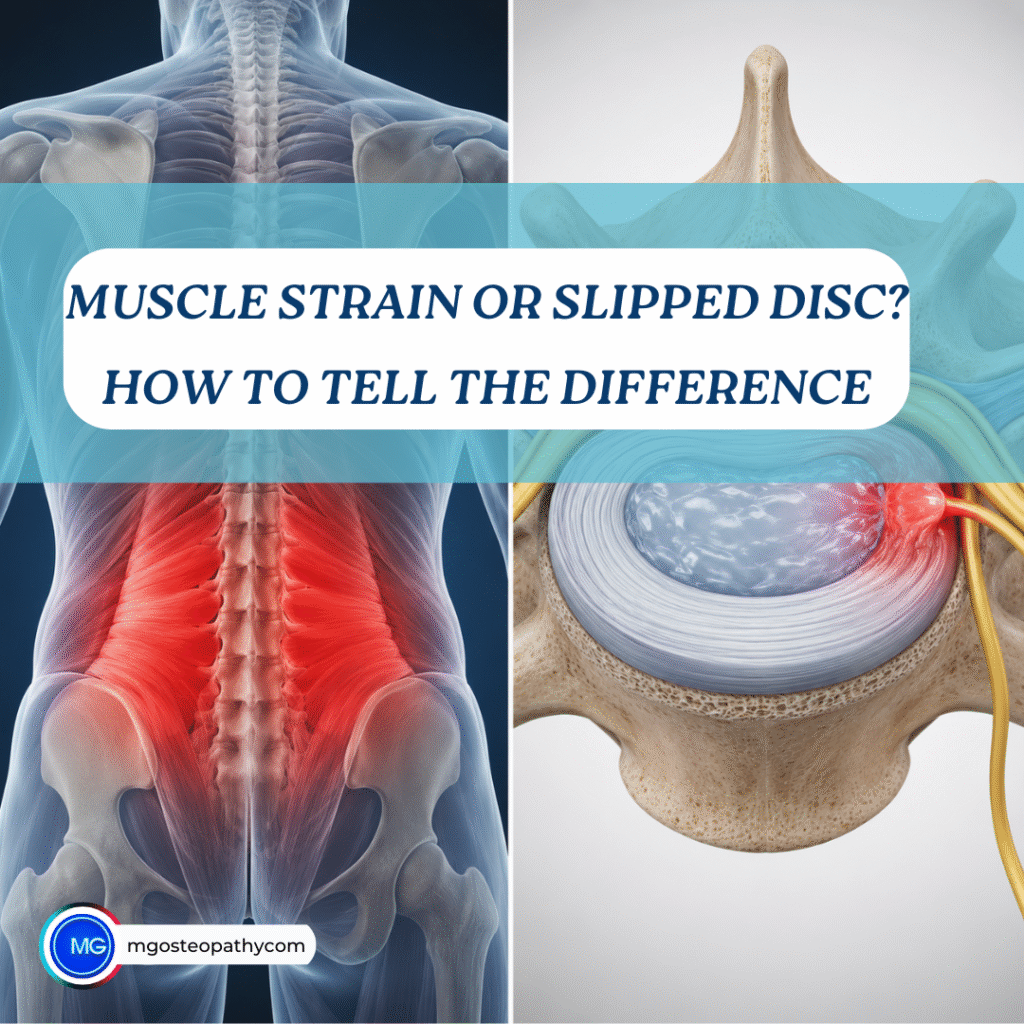
Back pain is something most people will experience at some point in their lives. But when it strikes, one of the first questions patients ask us at MG Osteopathy is: ” Is this a muscle problem or something more serious? ” The distinction matters. Muscle strain and a slipped disc can both cause significant pain and disruption to daily life — but they behave differently, respond to different approaches, and have different recovery timelines.
Understanding which one you are dealing with is the first step towards getting the right treatment.
Common Symptoms of Muscle Strain vs a Slipped Disc
While both conditions affect the back, their presentation is often quite different.
Muscle strain typically feels like:
- A dull, aching, or throbbing pain in the lower or upper back
- Stiffness and tightness that ease with gentle movement
- Localised pain that does not travel into the legs
- Soreness that worsens with specific movements or positions
- Symptoms that improve noticeably within a few days to weeks
- Tenderness when pressing on the affected muscles
A slipped disc may feel like:
- A sharper or more intense pain, often in the lower back
- Pain that radiates down one or both legs — commonly known as sciatica
- Numbness, tingling, or pins and needles in the leg or foot
- Weakness in the leg, foot, or toes
- Pain that worsens when sitting, coughing, or sneezing
- Symptoms that feel better when lying down in certain positions
If your pain is travelling down your leg with any numbness or tingling, a slipped disc is more likely to be involved and a professional assessment is strongly recommended.
What Is a Muscle Strain?
A muscle strain occurs when the muscles or tendons supporting the spine are overstretched or torn. This can happen suddenly — through lifting, twisting, or an awkward movement — or gradually through poor posture, repetitive strain, or prolonged sitting.
Muscle strains are extremely common and account for a significant proportion of the back pain cases we see at our Hackney and Islington clinics.
The good news is that most muscle strains respond well to treatment and resolve with the right approach. The surrounding muscles often go into protective spasm, which creates the intense tightness and difficulty moving in the early stages.
What Is a Slipped Disc?
Despite the name, a disc does not actually slip. The intervertebral discs sit between each vertebra in your spine, acting as shock absorbers. A slipped disc — more accurately called a herniated or prolapsed disc — occurs when the soft inner material of the disc pushes through a weakness in the outer casing.
This can place pressure on the nearby spinal nerves, which is what causes the radiating pain, numbness, and tingling that many people associate with a slipped disc.
The lower back, particularly between L4-L5 and L5-S1, is the most common site for disc herniations. This is why symptoms often travel down the back of the leg — following the path of the sciatic nerve.
A slipped disc does not always cause leg pain. In some cases, it presents purely as localised back pain, which is why professional assessment is important rather than self-diagnosing.
What Causes Each Condition?
Muscle Strain
- Sudden lifting, twisting, or bending movements
- Poor posture held over long periods — particularly common in desk workers
- Weak core or glute muscles, placing extra load on the back
- Overexertion during exercise or sport
- Fatigue causes a loss of proper movement control
Slipped Disc
- Gradual wear and tear on the disc over time
- Repetitive bending and loading movements
- Heavy or incorrect lifting technique
- Prolonged sitting and reduced disc hydration
- A sudden forceful movement on a spine that was already under strain
Age is also a contributing factor for disc issues, as the discs naturally lose hydration and elasticity over time — making them slightly more vulnerable to injury.
How Physiotherapy and Osteopathy Can Help
At MG Osteopathy in Hackney and Islington, we assess both muscle strains and disc-related problems as part of a thorough clinical evaluation. We do not simply treat the area that hurts — we look at how your whole spine, pelvis, hips, and movement patterns are contributing to the problem.
For Muscle Strain, treatment may include:
- Soft tissue massage and muscle release techniques
- Joint mobilisation to restore movement
- Targeted rehabilitation exercises for the core and supporting muscles
- Postural and movement advice to address the root cause
- Sports massage to reduce muscle tension and aid recovery
For a Slipped Disc, treatment may include:
- Gentle spinal mobilisation and neural tissue techniques
- Soft tissue work to reduce protective muscle spasm
- Specific exercises to centralise symptoms and decompress the nerve
- Progressive rehabilitation to build strength and prevent recurrence
- Shockwave therapy in appropriate cases to support tissue recovery
In both cases, the aim is the same — reduce your pain, restore your movement, and give you the tools to stop it coming back.
When Should You Seek Help?
Both conditions can often be managed conservatively with the right treatment and rehabilitation. However, there are certain situations where you should seek professional advice promptly.
See a healthcare professional if:
- Your pain is severe and not improving after a few days
- You have pain, numbness, or tingling traveling into your leg or foot
- You notice weakness in your leg, foot, or toes
- Symptoms came on after a fall, accident, or significant impact
Seek urgent medical attention if:
- You experience any changes in bladder or bowel function
- You have numbness in the inner thighs or groin area
- Your symptoms are rapidly worsening
These symptoms can indicate a more serious condition called cauda equina syndrome, which requires immediate medical assessment.
Back Pain Treatment at MG Osteopathy – Hackney and Islington, London
Whether you are dealing with a muscle strain, a disc problem, or are simply not sure what is going on with your back, MG Osteopathy offers thorough clinical assessment and effective treatment across Hackney and Islington.
We regularly help patients with lower back pain, sciatica, disc-related problems, postural strain, sports injuries, and recurring back flare-ups. Our approach is straightforward — find what is driving your symptoms, treat it properly, and give you a clear rehabilitation plan to reduce the chances of it returning.
📞 Any questions? Call us: +44 7809 575299
Frequently Asked Questions
How do I know if my back pain is a muscle strain or a slipped disc?
The key difference is whether your pain stays local to the back or travels into the leg. Muscle strains tend to cause localised aching and stiffness that eases with movement. A slipped disc more commonly produces radiating pain, numbness, or tingling into the leg or foot. A clinical assessment is the most reliable way to tell the difference.
Can a slipped disc heal on its own?
In many cases, yes. Research shows that disc herniations can reduce in size over time as the body reabsorbs the protruding material. However, this process takes time and the right management. Appropriate treatment and rehabilitation significantly improve recovery and reduce the risk of recurrence.
How long does a muscle strain in the back take to heal?
Most muscle strains improve within two to six weeks with appropriate treatment and activity modification. Strains that have been building gradually — such as those caused by prolonged poor posture — can take longer to fully resolve, particularly if the underlying movement habits are not addressed.
Can physiotherapy or osteopathy help with a slipped disc?
Yes. Both physiotherapy and osteopathy are well-established first-line treatments for disc-related back pain. Manual therapy, targeted exercises, and rehabilitation have strong evidence behind them for reducing pain, improving function, and supporting recovery without the need for surgery in the majority of cases.
📅 Ready to get assessed? Contact MG Osteopathy in Hackney and Islington to book your consultation.


