
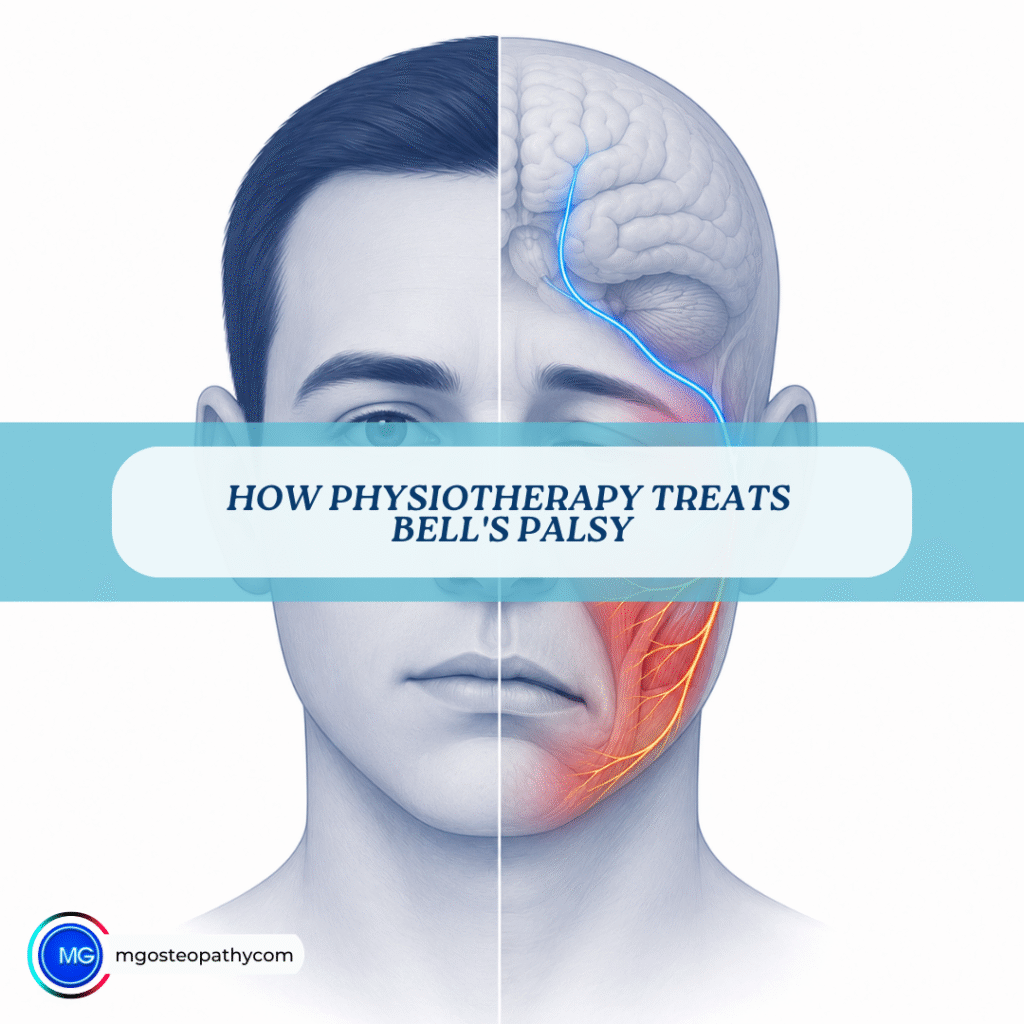
Bell’s palsy is a sudden and often frightening condition. Waking up to find one side of your face drooping, an eye that will not close, or speech suddenly difficult — the impact on daily life can be significant. The good news is that most people recover from Bell’s palsy. However, how quickly and how completely you recover depends heavily on how soon treatment begins. Physiotherapy — combined with targeted electrotherapy and muscle stimulation — plays a central role in supporting facial nerve recovery.
At MG Osteopathy in Hackney and Islington, we treat Bell’s palsy using a specialist electrotherapy unit that combines multiple evidence-based modalities. This guide explains what Bell’s palsy is, why early physiotherapy matters, and how our treatment approach supports recovery.
Common Symptoms of Bell’s Palsy
Bell’s palsy symptoms come on suddenly — typically over 24 to 48 hours. Common symptoms include:
- Sudden weakness or paralysis on one side of the face
- Drooping of the mouth, cheek, or eyelid on the affected side
- Inability to fully close the eye on the affected side
- Difficulty smiling, chewing, or speaking clearly
- Drooling due to reduced lip control
- Loss of taste on the front two-thirds of the tongue
- Increased sensitivity to sound on the affected side
- Pain or discomfort around the jaw or behind the ear
- Dry eye or excessive tearing on the affected side
Symptoms vary significantly in severity. Some patients experience mild weakness. Others have complete paralysis of one side of the face. Either way, early assessment and treatment are strongly recommended.
What Is Bell’s Palsy?
Bell’s palsy is the most common cause of acute facial nerve paralysis. It occurs when the facial nerve — the seventh cranial nerve — becomes inflamed and compressed as it passes through a narrow bony canal within the skull.
This inflammation disrupts the nerve’s ability to send signals to the facial muscles. As a result, one-sided weakness or paralysis develops. The exact cause is not fully understood. However, research strongly links Bell’s palsy to viral infections — particularly the herpes simplex virus — which trigger the inflammatory response within the nerve.
Bell’s palsy affects approximately one in 5,000 people per year in the UK. Furthermore, pregnancy, diabetes, and upper respiratory infections are recognised risk factors.
Why Does Early Physiotherapy Matter for Bell’s Palsy?
Early physiotherapy consistently improves outcomes for patients with Bell’s palsy. The facial nerve has the capacity to regenerate. However, without appropriate stimulation, the recovering nerve can form incorrect connections. This leads to synkinesis — where movements in one part of the face trigger involuntary movements in another.
Additionally, prolonged inactivity causes the facial muscles to lose tone and bulk. This slows functional return significantly. Early physiotherapy — combining electrotherapy, muscle stimulation, and neuromuscular retraining — maintains muscle activity and stimulates nerve regeneration.
Research consistently shows that patients who begin physiotherapy early achieve faster and more complete recovery than those who rely on medication alone.
How Physiotherapy Treats Bell’s Palsy
At MG Osteopathy in Hackney and Islington, our Bell’s palsy treatment combines specialist electrotherapy with hands-on physiotherapy and neuromuscular retraining. Together, these approaches address the nerve, the muscle, and the neuromuscular connection at every stage of recovery.
Electrotherapy — Our Combi 5-in-1 Unit
We use a specialist Combi 5-in-1 electrotherapy unit that combines five clinically proven modalities in a single treatment device. Each modality targets a different aspect of Bell’s palsy recovery. Together, they provide a comprehensive and highly effective treatment approach.
Interferential Therapy (IFT)
Interferential therapy uses two medium-frequency electrical currents. These currents intersect within the tissue to produce a low-frequency therapeutic effect deep in the affected area.
For Bell’s palsy, IFT reduces inflammation around the facial nerve, improves local circulation, and modulates pain. This makes it particularly valuable in the acute phase when the nerve is most inflamed. Furthermore, IFT penetrates more deeply than standard TENS — reaching the facial nerve within the bony canal more effectively. As a result, it is one of the most useful early-stage tools for managing Bell’s palsy.
TENS (Transcutaneous Electrical Nerve Stimulation)
TENS delivers low-frequency electrical impulses through the skin. These impulses stimulate sensory nerve fibres and modulate pain signals. For Bell’s palsy patients, TENS provides meaningful relief for the facial and post-auricular pain that often accompanies the acute phase.
Moreover, TENS stimulates nerve pathway activity — helping to maintain neural connections between the facial nerve and the facial muscles. This is important during the period when voluntary movement is reduced or absent.
Muscle Stimulation (MS)
Muscle stimulation is one of the most critical components of Bell’s palsy electrotherapy treatment. When the facial nerve cannot send normal signals to the facial muscles, those muscles begin to lose tone and bulk. Without intervention, this process accelerates rapidly.
Our electrotherapy unit delivers targeted electrical impulses directly to the affected facial muscles. These impulses produce controlled contractions that maintain muscle bulk and tone during nerve recovery. This matters for two key reasons.
First, it prevents the muscle atrophy that would otherwise develop. Second, and perhaps more importantly, it maintains the neuromuscular connection that the recovering nerve needs to reintegrate effectively. Stimulation parameters are carefully calibrated to the stage of recovery and the degree of paralysis at each session.
Therapeutic Ultrasound
Our unit delivers therapeutic ultrasound at a 1 MHz frequency. Intensity is adjustable from 0 to 3W/cm², in both continuous and pulsed modes. Duty cycle ratios of 1:1, 1:4, and 1:7 are available depending on the treatment goal.
For Bell’s palsy, therapeutic ultrasound serves two key purposes. First, in pulsed mode, it produces a non-thermal mechanical effect — reducing localised inflammation and oedema around the facial nerve. This is particularly useful in the acute phase, where reducing nerve compression within the bony canal supports early recovery.
Second, in continuous mode, therapeutic ultrasound produces a deep heating effect. This increases local tissue circulation and promotes repair. The 1MHz frequency suits deeper tissue penetration — reaching the facial nerve more effectively than higher frequencies used for superficial conditions.
Deep Heat Therapy
Deep heat therapy produces a sustained, penetrating warmth through the affected facial tissue. For Bell’s palsy patients, it increases local blood flow, reduces muscle stiffness, and creates a more favourable environment for nerve regeneration.
Furthermore, deep heat has a relaxing effect on the facial muscles. These muscles often develop secondary tension and guarding patterns during recovery — particularly around the jaw and cheek.
Neuromuscular Retraining
Alongside electrotherapy, neuromuscular retraining is an essential part of Bell’s palsy physiotherapy. As the facial nerve recovers, the brain needs to relearn how to send accurate movement signals to the facial muscles. This is particularly important where synkinesis has begun to develop.
Neuromuscular retraining for Bell’s palsy typically includes:
- Mirror biofeedback exercises — practising small, controlled facial movements to retrain movement quality and accuracy
- Facial muscle massage to maintain soft tissue health and reduce secondary tension
- Relaxation techniques for muscles that develop overactivity or synkinetic patterns
- Progressive facial expression exercises matched to the stage of nerve recovery
- Eye care guidance — including taping and lubricating drops where the eye cannot fully close
Facial Massage
Facial massage is an important supportive technique within Bell’s palsy physiotherapy. Gentle, specific massage of the affected facial muscles maintains circulation, reduces fibrotic changes within the muscle tissue, and supports soft tissue health during recovery.
At MG Osteopathy, facial massage is incorporated into treatment sessions alongside electrotherapy. Together, they provide a comprehensive approach that addresses both the nerve and the surrounding tissue simultaneously.
What to Expect During Bell’s Palsy Treatment at MG Osteopathy
Every Bell’s palsy patient begins with a thorough clinical assessment. We evaluate the degree of facial nerve involvement, the stage of recovery, the presence of any complications such as synkinesis, and your overall health history.
From this, we build a tailored treatment plan that selects the most appropriate electrotherapy modalities for your current stage of recovery. The plan progresses as the nerves and muscles respond to treatment.
Sessions typically last 45 to 60 minutes. They combine electrotherapy with hands-on treatment and exercise guidance. Between sessions, we provide a home exercise programme to maintain progress and support recovery outside of the clinic.
When Should You Seek Help for Bell’s Palsy?
If you develop sudden facial weakness or paralysis, seek medical assessment immediately. Bell’s palsy requires prompt diagnosis to rule out more serious conditions — including stroke — that can present with similar symptoms.
Seek emergency medical assessment if facial weakness is accompanied by:
- Arm or leg weakness on the same side
- Slurred speech or difficulty swallowing
- Sudden severe headache
- Visual disturbance
These symptoms suggest a stroke rather than Bell’s palsy. Consequently, they require immediate emergency care — not a physiotherapy appointment.
Once Bell’s palsy is confirmed, begin physiotherapy as early as possible. Early intervention consistently produces better outcomes and reduces the risk of long-term complications.
Bell’s Palsy Physiotherapy at MG Osteopathy – Hackney and Islington, London
If you are looking for Bell’s palsy physiotherapy in Hackney or Islington, MG Osteopathy offers specialist assessment and treatment using our Combi 5-in-1 electrotherapy unit alongside hands-on physiotherapy and neuromuscular retraining.
We regularly treat patients with Bell’s palsy, facial nerve palsy, and related conditions at both our Hackney and Islington clinics. Whether you are in the acute phase or further into your recovery, our aim is straightforward — to support your facial nerve recovery, maintain your facial muscle health, and reduce the risk of long-term complications.
📞 Any questions? Call us: +44 7809 575299
Frequently Asked Questions
How long does Bell’s palsy take to recover with physiotherapy?
Most people with mild to moderate Bell’s palsy notice significant improvement within three to six weeks. Complete recovery typically takes three to six months. Severe cases may take longer. Early physiotherapy consistently accelerates recovery compared to medication alone.
Can electrotherapy really help Bell’s palsy?
Yes. Electrotherapy — including muscle stimulation, IFT, TENS, and therapeutic ultrasound — has strong clinical support for Bell’s palsy management. It maintains muscle tone, reduces inflammation around the facial nerve, modulates pain, and supports the neuromuscular connection needed for effective recovery.
Will Bell’s palsy come back after recovery?
Bell’s palsy recurs in approximately 7 to 15% of cases. Recurrence can affect the same or opposite side of the face. Early and thorough treatment of the initial episode reduces — but does not eliminate — the risk of recurrence.
Is Bell’s palsy the same as a stroke?
No. Although both can cause facial weakness, Bell’s palsy affects only the facial nerve and produces one-sided facial weakness without affecting the arms, legs, or speech. A stroke typically produces additional neurological symptoms. If you are unsure, seek emergency medical assessment immediately.
Should I see a physiotherapist or osteopath for Bell’s palsy?
Physiotherapy is the primary recommended approach for Bell’s palsy rehabilitation. At MG Osteopathy, our physiotherapy team delivers specialist Bell’s palsy treatment — combining electrotherapy, facial massage, and progressive neuromuscular retraining for the best possible outcome.
📅 Ready to start your recovery? Contact MG Osteopathy in Hackney and Islington to book your Bell’s palsy physiotherapy assessment today.
