
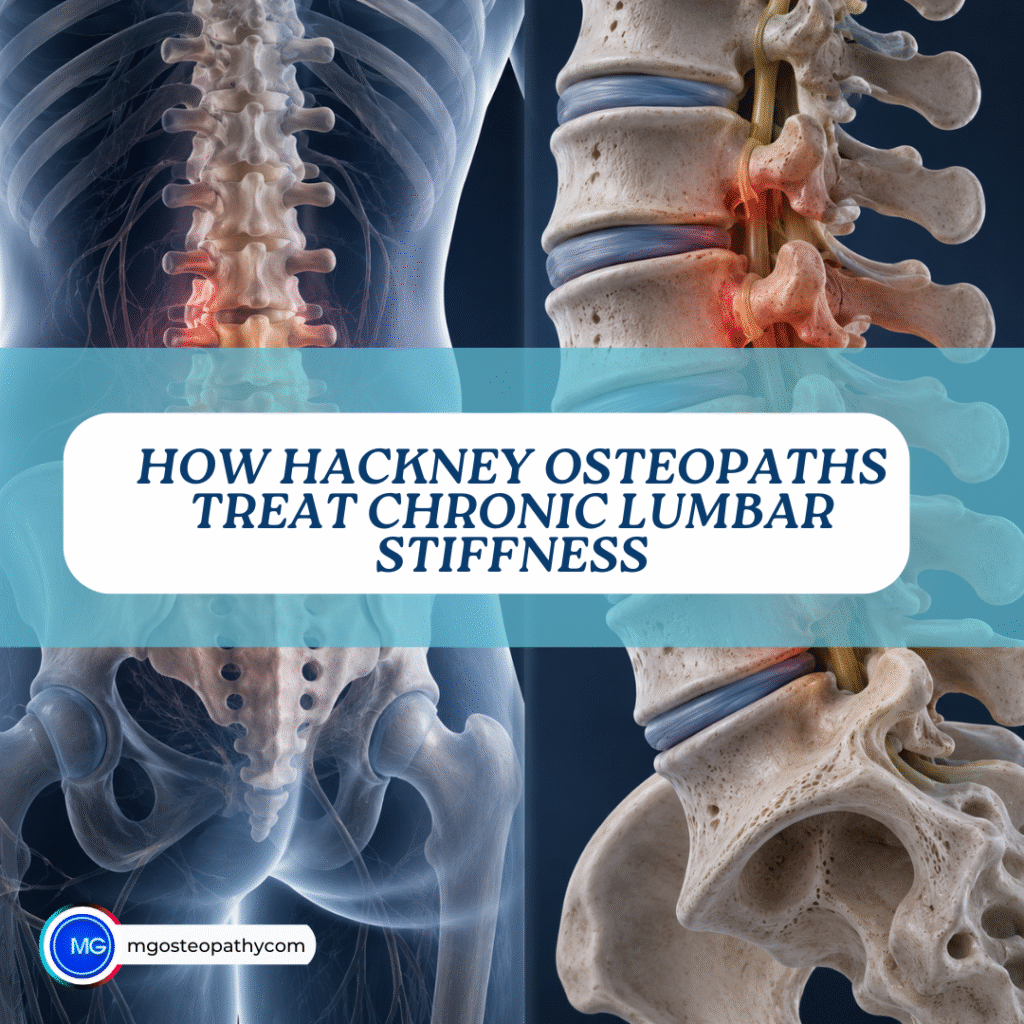
Chronic lumbar stiffness is something many people simply learn to live with. Stiff in the morning, uncomfortable after sitting, and never quite fully loose. It does not always cause sharp or dramatic pain, which is partly why so many people put off seeking help. At MG Osteopathy in Hackney, we see this pattern regularly.
Patients often tell us they have had a stiff lower back for months or even years. Many assume it is simply part of getting older. In most cases, it is neither.
Chronic lumbar stiffness is a treatable condition. Understanding what is driving it is the first step towards resolving it.
Common Symptoms of Chronic Lumbar Stiffness
Symptoms vary from person to person, but the pattern is often recognisable:
- Morning stiffness that takes time to ease after getting up
- A deep, persistent ache across the lower back
- Reduced ability to bend forwards, backwards, or rotate
- Stiffness that returns after prolonged sitting or standing
- Discomfort that eases with movement but never fully resolves
- A feeling of tightness or compression through the lower back
- Occasional flare-ups triggered by everyday activities
Many patients describe their stiffness as background noise — always present, occasionally louder, and gradually limiting what they feel able to do.
What Causes Chronic Lumbar Stiffness?
Chronic lumbar stiffness rarely has a single cause. Instead, it usually develops from a combination of factors that build up over time.
Reduced Spinal Mobility
The lumbar spine is designed to move through a full range of flexion, extension, and rotation. However, when movement is restricted through sedentary habits or injury, the joints and soft tissues gradually lose their normal range.
This creates a cycle. The less you move, the stiffer you become. And the stiffer you become, the less you want to move.
Muscle Imbalances and Weakness
Chronic stiffness is often maintained by muscle imbalances around the lumbar spine and pelvis. Tight hip flexors, weak glutes, and underactive deep core muscles are among the most common contributors we find during assessment.
When certain muscles overwork to compensate for weakness elsewhere, the lower back ends up under sustained load. As a result, that persistent, grinding tightness becomes very difficult to shift.
Prolonged Sitting and Sedentary Habits
Long periods of sitting reduce circulation to the spinal joints and soft tissues. They also compress the lumbar discs and allow the hip flexors and lower back muscles to shorten over time.
Furthermore, this gradually becomes the default resting state of the lower back. Normal movement then starts to feel restricted or uncomfortable.
Previous Injuries That Were Not Fully Rehabilitated
A previous back strain, disc injury, or acute pain episode can leave behind altered movement patterns and areas of restriction. These often persist long after the original injury has healed.
This is one of the most common reasons chronic stiffness develops. The acute episode resolved, but the underlying dysfunction was never fully addressed.
Age-Related Changes to the Spine
As we age, the intervertebral discs gradually lose hydration. Additionally, the facet joints can develop mild degenerative changes over time. This is a normal part of ageing and does not automatically mean pain.
However, it is worth being clear — degenerative changes on a scan do not tell the whole story. Many people with significant scan findings have little or no pain. Clinical assessment matters far more than a scan result alone.
How Osteopathy Treats Chronic Lumbar Stiffness
At MG Osteopathy in Hackney and Islington, we take a whole-body approach to assessing and treating chronic lumbar stiffness. Rather than focusing solely on the area of discomfort, we assess how your spine, pelvis, hips, and movement patterns all contribute to the problem.
Assessment
Every patient begins with a detailed assessment. We look at how you move, where restrictions exist, and which muscles are overworking or underperforming. We also identify any postural or lifestyle factors that may be maintaining the stiffness.
This gives us a clear picture of what is driving your symptoms — not just where they are.
Manual Therapy
Osteopathic treatment for chronic lumbar stiffness typically includes:
- Joint mobilisation to restore movement to restricted spinal segments
- Soft tissue techniques to release tight muscles and fascia around the lumbar spine and hips
- Myofascial release to address areas of chronic tension
- Neural tissue techniques where nerve irritation is a contributing factor
These hands-on techniques help reduce stiffness, improve circulation, and restore normal movement patterns.
Rehabilitation and Exercise
Manual therapy alone is rarely enough for chronic stiffness. Sustained improvement also requires rehabilitation work to address the underlying weakness and movement habits that allowed the stiffness to develop.
Your rehabilitation programme may include:
- Deep core activation and lumbar stabilisation exercises
- Hip flexor and hamstring mobility work
- Glute strengthening to reduce load through the lower back
- Movement pattern retraining for everyday activities
- Gradual return to exercise or sport where appropriate
Shockwave Therapy
For patients with stubborn muscular restriction, shockwave therapy can be a valuable addition to treatment. It stimulates tissue repair, reduces chronic muscle tension, and improves local circulation in areas that have not responded to manual therapy alone.
When Should You Seek Help for Lumbar Stiffness?
If your lower back stiffness has been present for more than a few weeks, it is worth getting a proper assessment. This is especially true if it is limiting your daily activities or keeps returning despite rest.
Chronic stiffness that goes unmanaged tends to worsen gradually. Moreover, the longer compensatory movement patterns remain in place, the more work is required to correct them.
Seek prompt medical advice if your stiffness is accompanied by:
- Pain or numbness travelling into the leg or foot
- Unexplained weight loss or night sweats
- Morning stiffness lasting over an hour — this can sometimes indicate an inflammatory condition such as ankylosing spondylitis
- Symptoms that came on after a fall or impact
Chronic Lumbar Stiffness Treatment at MG Osteopathy – Hackney and Islington, London
If you are dealing with persistent lower back stiffness in Hackney or Islington, MG Osteopathy offers thorough clinical assessment and hands-on treatment to help you move better.
We regularly treat patients with chronic lumbar stiffness, lower back pain, disc-related problems, hip and pelvic restriction, and postural strain. Whether your stiffness has been building for months or years, our aim is straightforward — identify what is driving it, treat it properly, and give you a clear plan to keep it from coming back.
📞 Any questions? Call us: +44 7809 575299
Frequently Asked Questions
Can osteopathy help with long-term lower back stiffness?
Yes. Osteopathy addresses restricted joints, surrounding soft tissues, and the movement habits that maintain the problem. Most patients notice an improvement in mobility within the first few sessions.
Is chronic lumbar stiffness the same as arthritis?
Not necessarily. While degenerative changes can contribute, many cases are driven by muscle imbalance and poor movement habits instead. A clinical assessment will identify what is driving your symptoms specifically.
How many osteopathy sessions will I need?
This depends on how long the stiffness has been present. Many patients see meaningful improvement within three to six sessions, though a longer rehabilitation programme often helps prevent recurrence.
📅 Ready to get assessed? Contact MG Osteopathy in Hackney and Islington to book your consultation.


